 2:01
The Vegas Loop: how The Boring Company moves people through tunnels in Teslas
Under Las Vegas, Tesla cars shuttle passengers through tunnels between hotels, the convention center and toward the airport. Here is how the Loop works, what a ride costs and where it is going next.
Of all the links between Elon Musk's companies, The Boring Company's Vegas Loop is the one you can actually ride today. Under Las Vegas, ordinary Tesla cars carry passengers through tunnels between stations at hotels and the convention center. With the company planning to double its number of stations this year, here is how it works.
What the Loop is
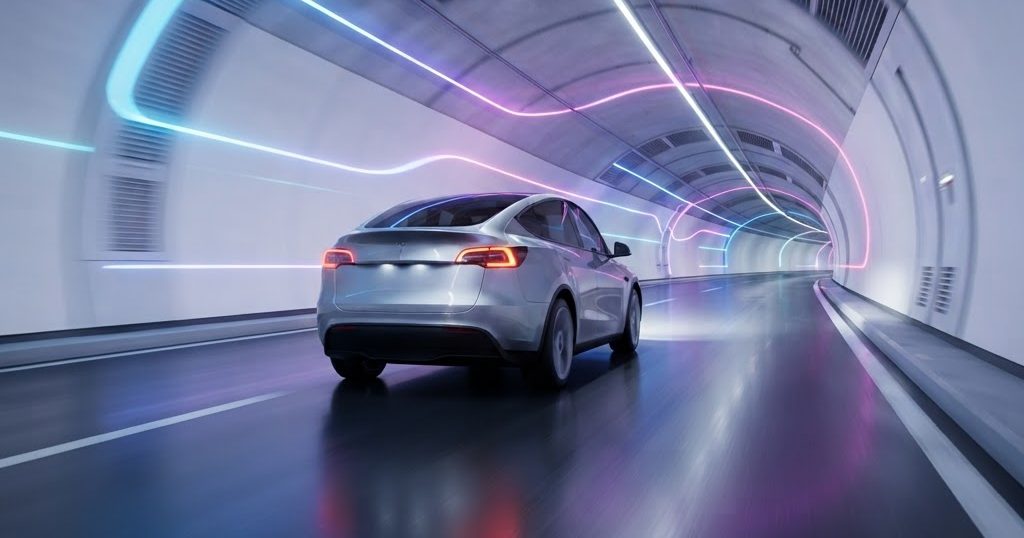
The Loop is not a train or a subway. It is a network of narrow tunnels, about the width of a car, through which Tesla vehicles drive passengers point to point between stations. There are no intermediate stops: you get in, tell the driver or the app where you are going, and the car takes you there.
Where it runs
- Stations: Encore, Resorts World, Westgate and several locations at the Las Vegas Convention Center.
- Tunnels: more than 10 miles (about 16 km) have been dug, of which around four miles (about 6.5 km) were operational at the start of 2026.
- Expansion: The Boring Company said in September that it plans to double its number of stations by the end of 2026.
To the airport
Since just before CES in January 2026, the Loop offers limited rides to Harry Reid International Airport. For now, it only drops passengers off at the departures curb, daily from 10 a.m. to 9 p.m. A ride from Resorts World or Westgate to Terminal 1 or 3 costs around $12. Because the tunnels do not yet reach under the airport, the trip combines a tunnel section with a short stretch on surface streets. Pick-ups at the airport are planned once the cars are fitted with the required transponders.
The Tesla connection
Every car in the Loop is a Tesla. That makes the Vegas Loop a daily showcase for Tesla vehicles, and a natural candidate for driverless operation: a closed tunnel network with fixed routes is a far simpler environment than open city streets. Tesla's robotaxi software already runs without a safety driver in several US cities, so using it underground is an obvious next step, although no date has been announced.
Money and new cities
The Boring Company recently raised $3 billion in a funding round that valued it at $23 billion. The money is meant for expansion to more cities: a new loop has been announced for Nashville, Tennessee, and filings point to an underground loop in downtown Austin, Tesla's home city.
Why it matters
On its own, the Loop is a niche transport system. As part of Musk's ecosystem, it is a place where Tesla cars, software and possibly future driverless operation come together, and one more piece in the debate about how closely Musk's companies are tied.