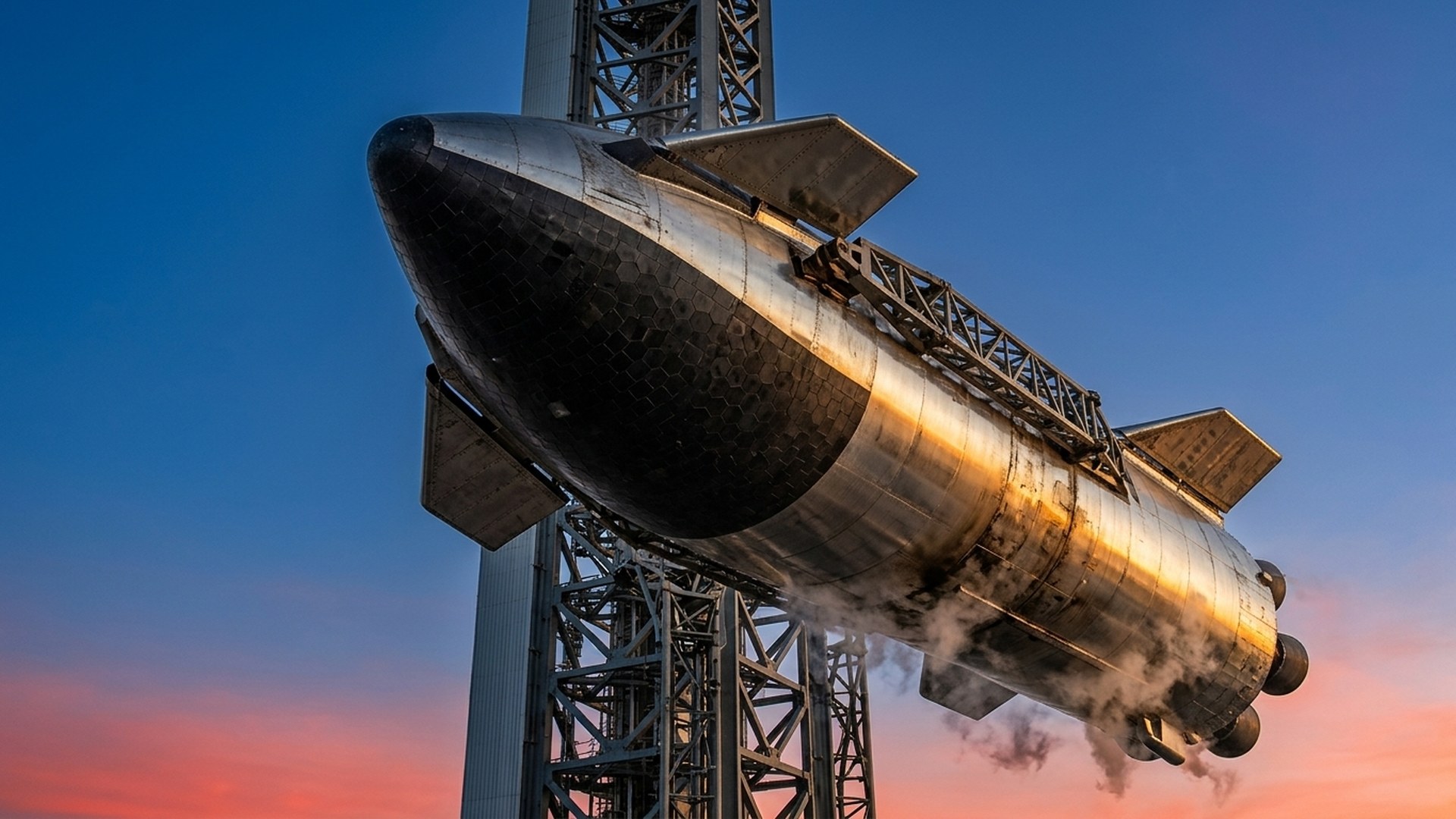
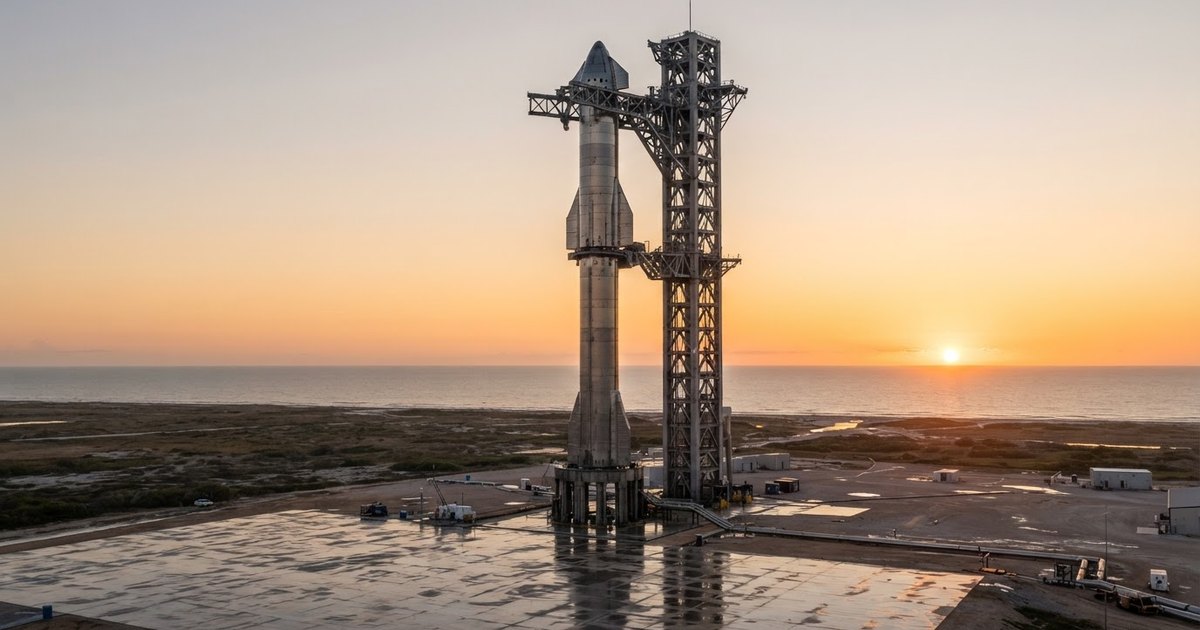
Starship's first flight ended in a crater
In April 2023 Starship's first flight lasted four minutes, wrecked its own launch pad and had to be blown up. This is how that failure set up the attempt to catch both halves of the rocket.
At 8:33 in the morning on April 20, 2023, the tallest rocket ever built lifted off from Starbase in South Texas, and it was in trouble before it cleared the tower. Three of its 33 engines had already been switched off by the flight computer because they did not look healthy. Four minutes later the whole thing had been blown apart over the Gulf of Mexico. Elon Musk had set the bar low beforehand, putting the odds of success at about 50% and asking for one thing: "Just don't blow up the launchpad." When the dust settled, there was a crater under the launch mount. The rocket that was supposed to land back in the arms of its own tower one day had just damaged the ground it stood on.
What actually went wrong in those four minutes?
Fires in the tail of the Super Heavy booster cut most of its engines off from the flight computer. According to SpaceX's own findings, propellant leaked in the aft end of the booster and caught fire during the climb. About 27 seconds in, the team lost contact with another engine after a sudden, violent event in the engine bay. Around 85 seconds, steering was lost for the 13 central engines. The rocket peaked at roughly 39 km and started to loop instead of climbing. Separating the ship from the booster was planned at about two minutes and fifty seconds, but with too little thrust and no control, it was never even attempted. The stack simply tumbled. At about three minutes and ten seconds the self-destruct system was triggered, yet the booster's engines kept firing for another 40 seconds before the vehicle finally broke up. Musk later admitted the system had been far too slow. Losing the rocket was half of the damage. The other half was waiting back on the ground.
Why did the launch pad break?
The pad had no flame trench and no water system to soak up the blast of 33 engines. That was a deliberate choice. In 2020 Musk had written that he hoped to do without a flame diverter at Starbase, while admitting that this might turn out to be a mistake. Static fire tests had convinced the team that the heat-resistant concrete under the mount would survive at least one launch. It did not. Partly because the engines took almost 10 seconds to push the rocket clear, the exhaust gouged a crater under the mount and threw chunks of concrete hundreds of metres. Debris was found across some 385 acres, a small fire burned in the neighbouring state park, and a cloud of dust drifted over nearby towns (it turned out to be harmless beach sand). The FAA grounded Starship while it investigated. SpaceX now had to rebuild both its rocket and its pad before it could fly again.
So what did SpaceX change?
More than a thousand things, and four of them mattered most. By July 2023 the company counted over 1,000 changes. Under the launch mount it installed a thick steel plate full of holes that blasts water upward at liftoff, absorbing the energy of the engines instead of letting it hit concrete. On the booster, the hydraulic system that steers the engines was replaced with electric actuators, which keep the engines better isolated from each other. The self-destruct system was reworked after its 40-second delay. And the way the stages separate changed completely: with "hot staging", the ship lights its own engines while still sitting on the booster and pushes itself away, which SpaceX expected to add about 10% payload. On September 8, 2023, the FAA closed its investigation with a list of 63 corrective actions. Fixes on paper, however, only count once they fly.
Did the fixes actually work?
Yes: the exact things that broke on the first flight were the first things to work on the next ones. On Flight 2, in November 2023, the ship separated from its booster with the new hot-staging method, even though both stages were lost later in that flight. From there the programme kept repeating the same loop of flying, breaking and fixing. On Flights 5, 7 and 8, a returning Super Heavy booster was caught by the tower's "chopstick" arms, something no rocket had ever done. On September 28, 2026, Flight 14 became the first Starship to reach orbit and released 26 Starlink V3 satellites before splashing down in the Pacific. One half of the rocket, though, has still never come home in one piece.
Why does that first flight still matter?
Because it showed how SpaceX builds: fly early, break things in public and fix them fast. Most rocket makers test for years before a first launch; SpaceX launched a vehicle it expected to lose and treated the explosion as data. That same approach shows up at Tesla, Musk's other company, from rapid factory changes to the stainless steel that Starship and the Cybertruck share. In November 2026 it was pointed at the boldest test yet: Flight 15 was planned to catch both halves for the first time, the booster about six and a half minutes after liftoff and the ship after more than 22 hours and 14 orbits. Musk called a successful ship catch "more likely than not", a prediction rather than a fact. SpaceX itself described it as the first full recovery of an orbital launch system. Whatever happens on any single flight, the arc is hard to miss. The rocket that once dug a hole in its own launch pad is now trying to land back in the arms of its tower.
Sources (4)
Images are illustrations; some are made with AI.