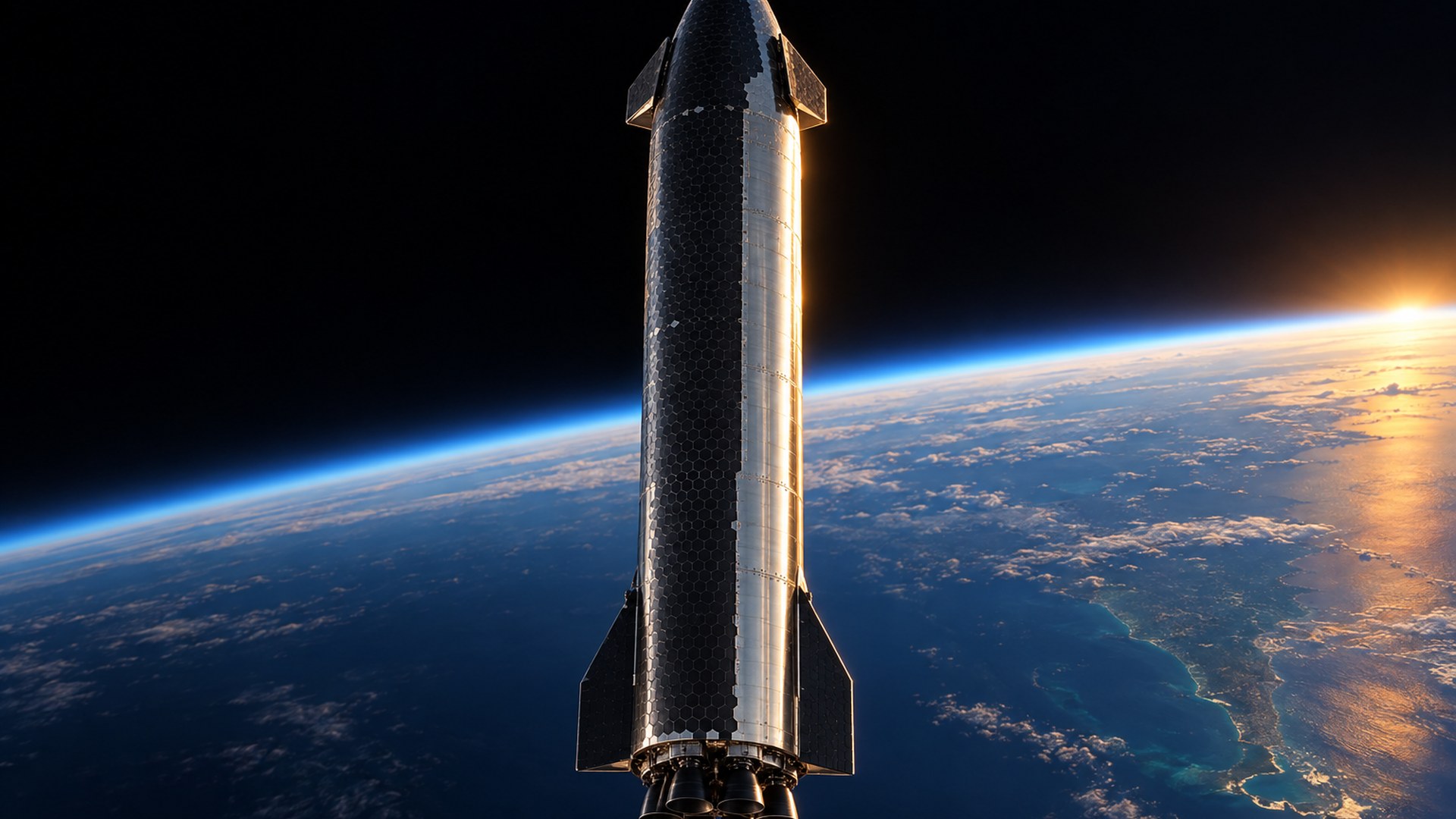
SpaceX catches Starship without wings or legs
SpaceX wants to catch both Starship stages with its launch tower. How a ship without wings falls belly first, flips upright and lands in the tower's arms, why that is harder than catching the booster, and how it lands on the Moon instead.
On Starship Flight 15, planned for November 2026, SpaceX wants to do something no rocket has ever done: bring both stages back to the launch site and catch them with the tower. The Super Heavy booster has already been caught three times. The upper stage, simply called Ship, never has. On SpaceX's third-quarter earnings call on October 20, Elon Musk said a success would be the first time an orbital launch vehicle is fully recovered, and he called it "more likely than not". Booster 22 and Ship 42 have both finished their engine tests. Yet the ship that is supposed to come home from orbit has no wings, no landing legs and no parachutes. It looks like a spacecraft that is missing every part you normally need to land.
Why does Starship have no wings like the Space Shuttle?
Because wings are heavy, and Starship is built for places without runways. The Space Shuttle came home as a giant glider: it used its wings to fly through the atmosphere and rolled to a stop on wheels on a long runway. That worked, but the wings and the landing gear had to be carried all the way to orbit and back, and they only help where there is thick air and a strip of concrete. Starship is meant to land on Earth, the Moon and Mars. The Moon has no air at all, and Mars has very thin air and no runways. A ship that depends on wings would be stuck at home.
Parachutes are no answer either. For a vehicle of this size they would have to be enormous, they open too slowly to help if an engine fails late, and they add a lot of mass. So SpaceX left out wings, wheels and parachutes. That leaves a steel ship falling out of the sky with nothing obvious to slow it down.
So how does a ship without wings slow down?
It falls belly first, like a skydiver, and uses its whole body as an air brake. After re-entry, Starship drops through the atmosphere lying flat, with its side of black hexagonal heat shield tiles facing down. Four flaps, two near the nose and two at the base, work like a skydiver's arms and legs: they steer the ship and keep it stable.
Lying flat makes a huge difference. An analysis by Everyday Astronaut puts the side of the ship at about 545 square metres facing the air, against roughly 70 for its base: almost eight times as much area to push against. In the flight plan of the early SN8 prototype, that slowed the ship to about 90 metres per second before its engines lit. A Falcon 9 booster, which falls engine first, is still doing around 310 metres per second when it starts its landing burn. The slower you fall, the less fuel the final braking costs. But falling flat is only half a landing, because the ship has to end up standing upright.
How does the tower catch the ship?
The ship flips upright at the last moment and drops between the tower's arms. In the animation SpaceX showed on its earnings webcast, the ship comes in horizontally over Starbase in South Texas and steers with its flaps. Then a short engine burn swings it vertical and slows it down. It descends past the top of the tower, and the two arms, nicknamed the chopsticks, close around it.
The arms do not squeeze the steel hull. The vehicles carry catch pins that come to rest on rails on the arms, which take the weight and absorb the shock. SpaceX has practised the flip for years: prototypes such as SN8 and SN15 did it after falling from around 10 kilometres up in 2020 and 2021, and on later test flights ships flipped and hovered over the Indian Ocean before tipping into the water. This time, though, the ship comes down next to land, buildings and the hardware SpaceX needs for every future flight.
Why is catching the ship harder than catching the booster?
Because the ship comes back from orbit, not from the edge of space. The booster separates a few minutes after liftoff, turns around and is back at the tower within minutes. The ship first has to finish its orbital flight, survive re-entry at orbital speed, and only then line up with a tower in Texas. If anything cuts the mission short, it never comes back over Starbase at all.
- Engines: the new Raptor 3 engines have had problems on each of their first flights, Gizmodo noted. On Flight 14, on September 28, an engine shut down early, although the ship still reached orbit and released 26 Starlink V3 satellites.
- Heat: the tiles and flaps must come through the hottest part of the flight in good enough shape to steer precisely.
- Location: a ship returning from orbit to a catch flies toward land instead of the open sea, so the FAA licence has to allow a return to the launch site and tower catches for both stages, which SpaceX president Gwynne Shotwell said she expects.
The booster, by the way, does not get in the way: according to Gizmodo, it uses the other tower at Starbase. Catching one of each in a single flight would turn the whole rocket into hardware that can be used again. On the Moon and Mars, though, there is no tower at all.
So how will Starship land on the Moon and Mars without a tower?
On its own legs. No tower waits on the Moon, so Starship HLS, the version NASA has hired as the lunar lander for its Artemis astronauts, gets landing legs. As early as 2020, Musk wrote that SpaceX was working on new legs with a wider stance that can level themselves on uneven ground, together with thrusters high on the hull to keep the ship steady during landing. Because that ship does not come back through Earth's atmosphere, it does not need a heat shield or flaps. The first ships on Mars will face the same problem: whatever SpaceX builds there later, the first landings happen on bare ground. The tower catch is an Earth trick, made for one thing: flying again fast.
What would a double catch change?
It would make Starship the first orbital rocket that comes home in one piece. Falcon 9 already lands its booster, but its upper stage is thrown away on every flight. A caught ship could be inspected, refuelled and, in theory, flown again. That is the whole idea behind the design: much cheaper launches for Starlink, for NASA's Moon missions and for Musk's Mars plans, where Tesla's Optimus robot is meant to play a role. A possible merger of SpaceX and Tesla is being studied, so Tesla shareholders watch these flights too.
A first attempt can still go wrong; even Musk only called success more likely than not. But the strange design makes sense once you see the whole plan. Starship has no wings, no legs and no parachutes because the tower is its landing gear.
Sources (4)
Images are illustrations; some are made with AI.