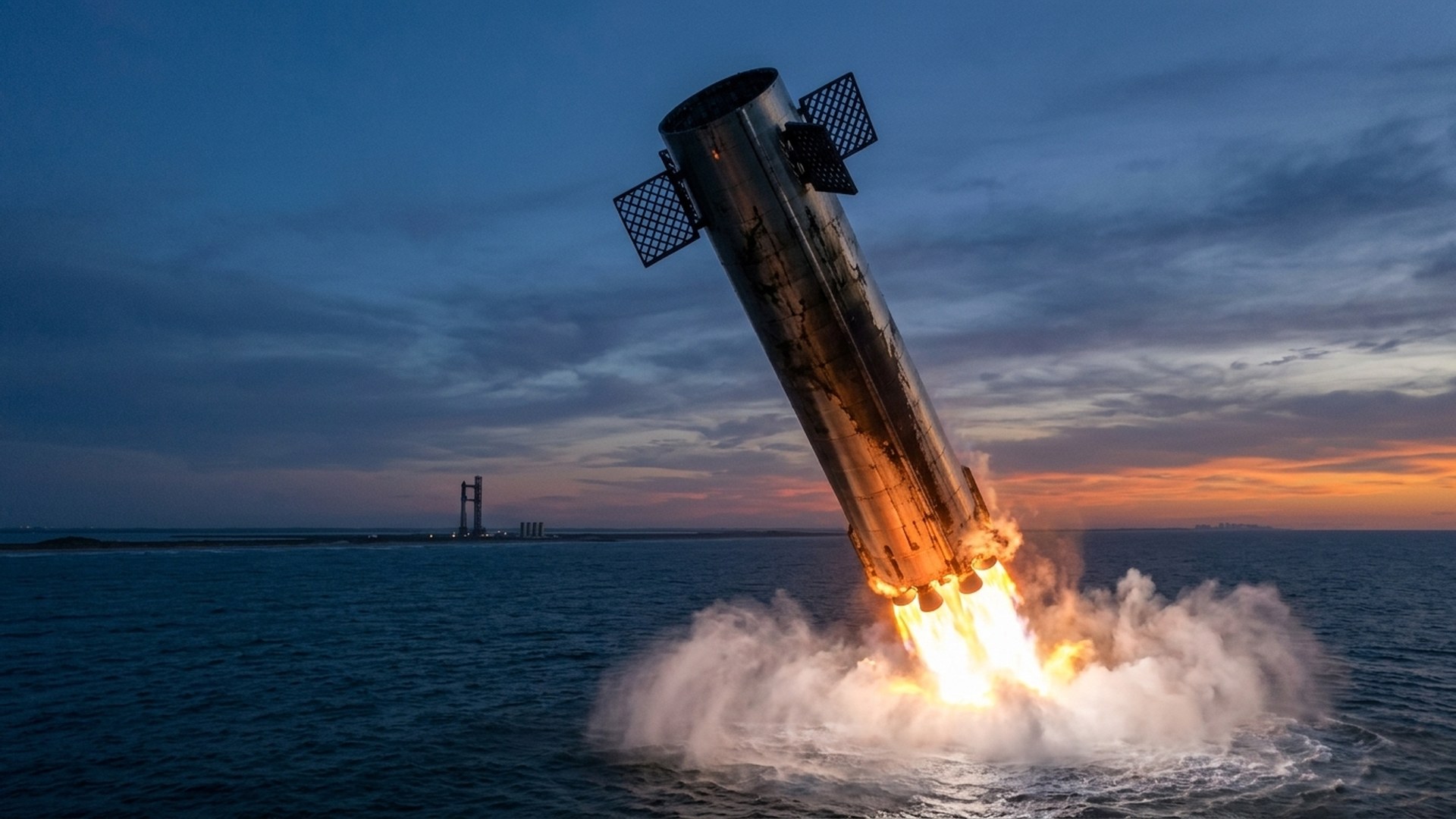
SpaceX catches a Starship for the first time
SpaceX has caught a Starship upper stage returning from orbit for the first time. Ship 42 flew for 22.5 hours on Flight 15 before the Starbase tower's arms closed around it; the booster's catch was called off.
SpaceX has caught a Starship coming back from orbit. On Saturday 14 November 2026, at about 3:20 p.m. Texas time, the two arms of the launch tower at Starbase closed around Ship 42, the upper stage of Starship Flight 15. "Mechazilla catches Starship!" SpaceX wrote on X. No spacecraft had ever returned from orbit to be caught by the tower it left from. The other half of the rocket did not make it back, which makes the question of what exactly happened worth a closer look.
What exactly did SpaceX catch?
The ship: the upper stage that goes all the way to orbit. Flight 15 lifted off from Starbase on Friday 13 November at 4:47 p.m. Texas time. Ship 42 reached an orbit about 275 kilometres up and released 26 Starlink V3 satellites. It then stayed in space for more than 21 hours, about 14 trips around the Earth, until its path once again passed over Texas. The catch came 22 hours and 32 minutes after liftoff. Coming home from orbit is far harder than coming home from the edge of space, and that is the part that was new.
So how do you catch a ship that comes back from orbit?
Without legs, wings or a parachute. The ship falls through the atmosphere belly first, so its heat shield takes the heat and the air slows it down. Close to the ground it relights its engines, swings upright and settles between the tower's two arms, nicknamed chopsticks, where catch pins on the ship come to rest on the arms. SpaceX had done this three times with the Super Heavy booster, most recently in March 2025, but a booster only comes back from the edge of space, minutes after launch. The ship returns at orbital speed after a day in space. That leaves the half of the rocket that was supposed to be the routine part.
Why was the booster not caught?
Its catch was called off on Friday, minutes after launch. SpaceX wanted to catch both halves on this flight. According to SpaceX's Dan Huot the booster, Booster 22, aborted its own return after detecting a guidance and navigation problem. Elon Musk wrote that the booster was "slightly low on fuel" because its engines had slightly underperformed. It came down in the Gulf instead and was lost. So the double catch did not happen, and the first reused ship is still to come.
So why does this catch matter?
Because the upper stage is the part every other rocket throws away. Falcon 9 lands its booster, but its upper stage burns up on every flight. A ship that lands back in the tower's arms can, in principle, be checked, refuelled and flown again, and that is what SpaceX needs for its Starlink V3 launches and for the tanker flights of NASA's Moon lander. Musk says he expects weekly Starship launches in the first half of 2027. That is his forecast, not a fact: Ship 42 still has to be inspected, and no ship has flown twice yet.
How the booster and the ship return in such different ways is explained in our explainer on the double catch.
Sources (4)
- Teslarati — SpaceX makes history, catching Starship from orbit for the first time
- Starlust — SpaceX scripts history by catching Starship's upper stage using launch tower for the first time
- Space.com — SpaceX launches Starship on ambitious 22-hour Flight 15 test, but aborts booster 'chopsticks' catch
- Drive Tesla — SpaceX Catches Starship After Historic Return From Orbit on Flight 15
Images are illustrations; some are made with AI.