SpaceX Caught Starship After 22 Hours
On Flight 15, SpaceX caught the Starship ship 22 hours and 32 minutes after liftoff. The booster's catch was aborted over the Gulf. The 22-hour figure is SpaceX's own timeline.
SpaceX caught a Starship coming back from orbit. On Flight 15 the ship left Pad 2 at Starbase, Texas, on Friday 13 November 2026 and was in the launch tower's arms on Saturday. SpaceX says it approached the same site 22 and a half hours after liftoff. The company's timeline, which it marks as approximate, puts the catch at 22 hours, 32 minutes and 34 seconds. The booster that lifted the ship did not come back to the tower.
What did SpaceX catch?
The ship, on its first return from orbit to the tower. SpaceX's flight page says Starship completed its ascent, reached orbit on a short burn from a single Raptor, and deployed 26 Starlink V3 satellites. Contact was made with every satellite, and SpaceX says they were already raising their orbits. After more than 20 hours of monitoring, one sea-level Raptor fired a deorbit burn of about 10 seconds. The ship entered, went from supersonic to subsonic in under a minute, lit a landing burn, flipped, and stepped from three engines to two and then to one. The arms, which SpaceX calls Mechazilla, closed. SpaceX says that was the first time. Spaceflight Now and Space.com both time the catch at 3:20 p.m. Texas time on 14 November, and both name the vehicle Ship 42. SpaceX's own page does not use that serial number.
So what happened to the booster?
Its catch was aborted, and the stage was lost offshore. SpaceX says the booster left on 33 Raptors, then relit 32 of a planned 33 for the boostback burn. That burn ended early because of low fuel mass. The root cause, SpaceX says, is still under investigation. Guidance, navigation and control then triggered an automated abort during the coast and diverted the booster to an offshore site. It flew a landing burn, the engines cut off while it was hovering over the Gulf, and the flight termination system fired. Spaceflight Now reports that the booster exploded at sea. The same outlet and Space.com call this stage Booster 22. One line on SpaceX's timeline still reads "landing burn shutdown and catch" at 6 minutes 35 seconds. That table is labelled approximate. The flight report above it is the account of what happened, and that account does not include a booster catch.
Why did the ship take 22 hours?
It was in orbit, and SpaceX watched it through earlier chances to come down. The booster never reached orbit, so its return was a matter of minutes. The ship did reach orbit, and SpaceX describes a long coast rather than a missed landing. The timeline lists an early return check near Hawaii at 1 hour 28 minutes, a check near Chile at 7 hours 16 minutes, and a final Hawaii check at 20 hours 42 minutes. Spaceflight Now reports that splashdowns off Hawaii or Chile were available and were not used. The deorbit burn comes after that final check. SpaceX does not call the wait a failure.
How did the catch itself work?
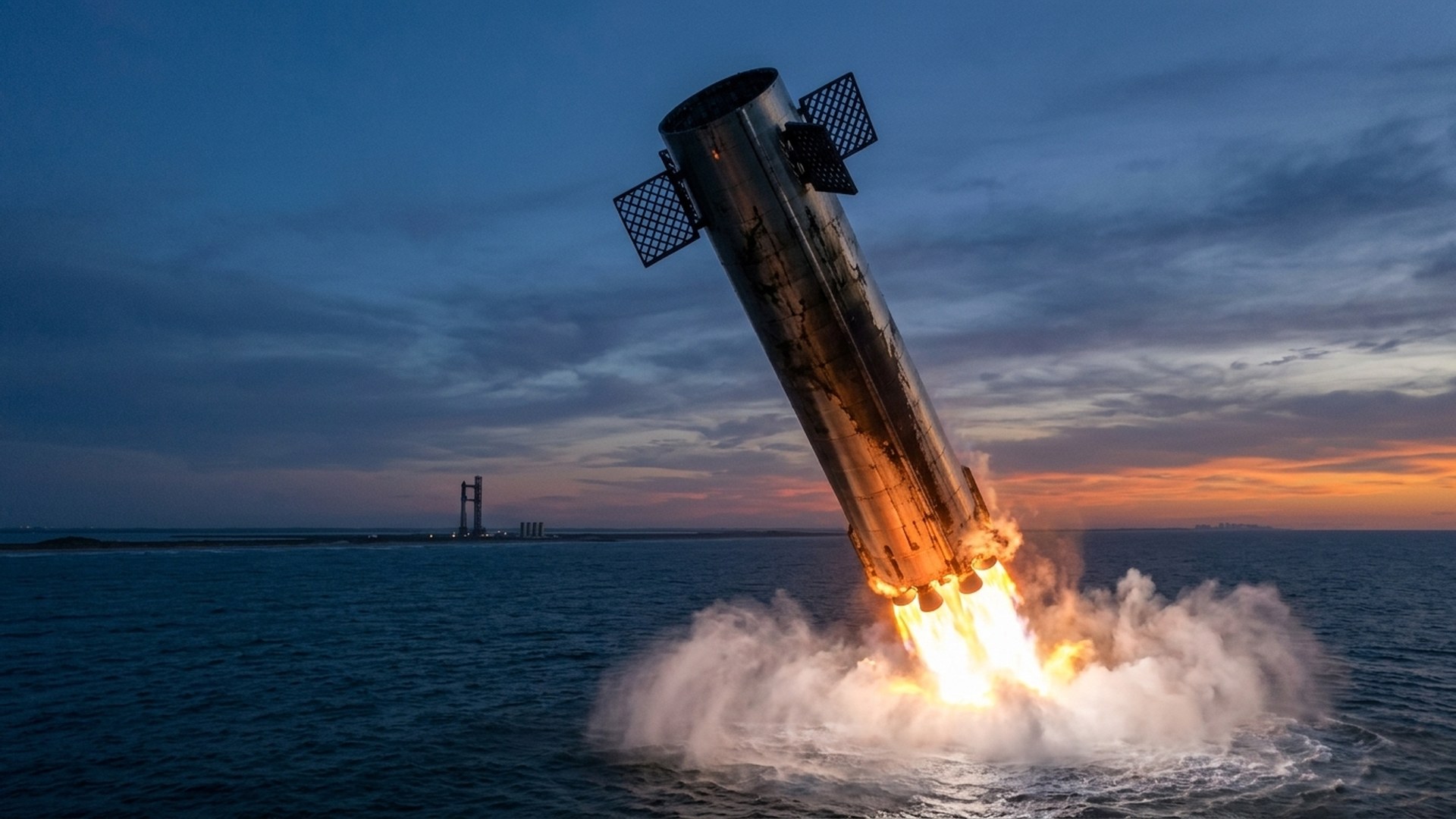
Engines, a flip, and the arms. SpaceX's timeline starts the landing burn at 22 hours, 32 minutes and 16 seconds, with the flip two seconds later, then three engines to two, then two to one, then shutdown and the catch in the same second. The page says the ship flew a last swoosh over the Gulf and came down through the clouds into the arms. The published sequence does not include a parachute or a splashdown of the ship. Pictures in this article and in the video are diagrams and library illustrations of a Starship and a tower. They are not frames from the Flight 15 webcast.
What is still open?
The cause of the low fuel, and whether this ship flies again. SpaceX says the early end of the boostback burn is under investigation. It has not reported a second flight of the caught ship. Space.com reports that Super Heavy had already been caught on three earlier flights, so the new event is the ship, not the idea of a tower catch. A caught ship can be inspected. That is not a date for the next launch, and it is not a landing on the Moon or Mars. The next hard fact is whatever SpaceX publishes on the fuel investigation, and whether Ship 42, as the press identifies it, is stacked again.
Sources (3)
Photos: TrendingTesla library illustrations of a Starship stack, a liftoff and Starlink satellites. Not photographs of Flight 15; Diagrams drawn for this article from the SpaceX Flight 15 timeline. Not photographs. Other images are illustrations; some are made with AI.