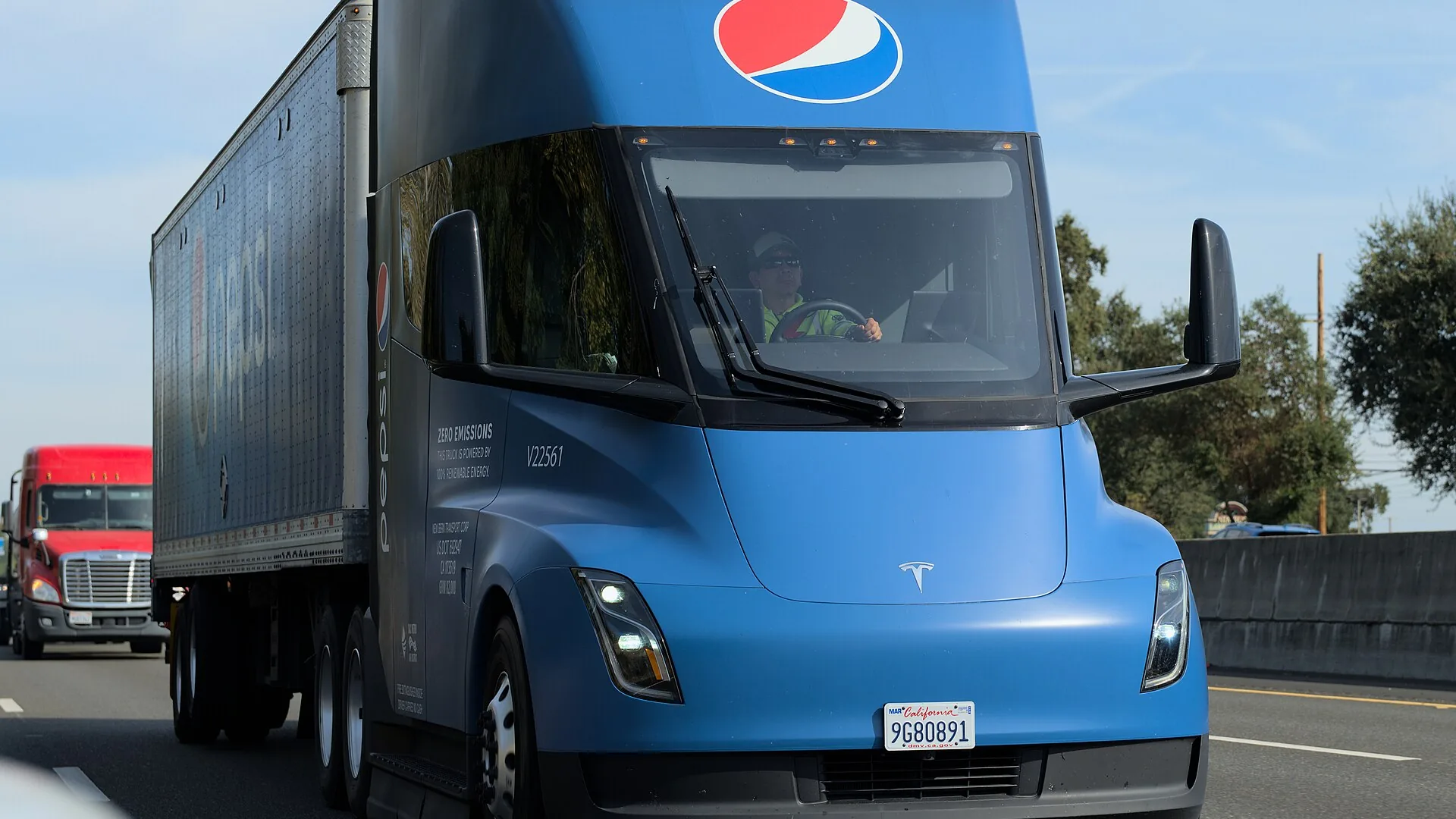
PepsiCo Tesla Semi, 31 October 2023. The 2022 pilot, not the 2026 truck. Photo: Dllu, CC BY-SA 4.0.
The 2022 Pilot is the first-generation Semi, hand-built for PepsiCo and other early fleets. It used 2170 cells and hydraulic steering, and it proved the 500-mile claim in real freight work.
What this truck is
Fact
Value
Status
Status
Hand-built pilot line at Giga Nevada. First handover to PepsiCo on 1 December 2022. Superseded by the 2026 production truck. Many are still in service
reported
Model year
NHTSA recalls list these trucks as model year 2023. Recall 23V-422 covers production from 30 November 2022 to 15 March 2023
official
How many
Priestley in September 2026: just under 200. MotorTrend: nearly 200. Another report: about 180. By October 2023 the count in the press was 60–70 built
reported
Fleet-size wording differs: just under 200, nearly 200, about 180, and a few hundred. No single audited count is published.
548 kWh, 822 kWh, 4680 cells, electric steering, MCS 3.2 and the full-width light bar belong to the 2026 truck, not this one.
2022 specification
Fact
Value
Status
Range
The 2022 spec text offered about 300 or 500 miles at 82,000 lb. The trucks that were delivered were the 500-mile version
official
Battery
Purchased 2170 cells. Musk said around 900 kWh for 500 miles. No certified kWh figure was found
reported
Voltage
1,000 V powertrain, Priestley in 2022
official
Motors
Three motors: one cruise motor that stays engaged, and two clutched torque motors, with carbon-sleeved Plaid-type rotors. This page does not assign those motors to an axle
official
0–60 mph
20 seconds at 82,000 lb
official
Grade
The highway speed limit on a 5% grade. A video showed a loaded climb of 6% toward Donner Pass while overtaking
official
Consumption, spec
Under 2 kWh per mile
official
Fast charge
Up to 70% of range in 30 minutes. A liquid-cooled charger of about 1 MW was announced. The early fleet used MCS 2.4. Do not apply 1.2 MW or MCS 3.2 here
official
Steering and window
Hydraulic power steering. A pop-out side window
reported
Cab
Day cab, centre seat, jump seat. The older front end used vertical lights
reported
Curb weight
Not announced. Tesla has said the 2026 truck is about 1,000 lb lighter than this earlier one
not announced
Price
Not announced. The 2017 list prices do not apply to what PepsiCo paid
not announced
The Verge wrote “four motors” in December 2022. Tesla and InsideEVs said three. This page uses three.
2022 coverage disagreed about which axle held the cruise motor. The 2026 truck’s mid-axle and rear-axle layout is not copied onto this pilot.
The 500-mile run
Fact
Value
Status
Route
Fremont to San Diego, the PepsiCo site at Lakeside, at about 81,000 lb GCW, on one charge. Reported state of charge 97% down to 4%, about eight hours including a break
official
Date
15 November 2022 in one account, 25 November 2022 in another. The day is not settled
conflict
Fleet consumption
Fact
Value
Status
PepsiCo, 2023
1.7 kWh per mile or under
reported
NFI, August 2024
1.64 kWh per mile over 6,000 miles
reported
DHL, October 2024
1.72 kWh per mile, and 390 miles at 75,000 lb
reported
NREL
Modelling on the Run on Less data: 1.78 kWh per mile
reported
PepsiCo at IAA 2024
A stated average of 0.8 kWh per km, about 1.29 kWh per mile. That is a PepsiCo fleet average, including light Frito-Lay loads. It is not a Tesla spec
conflict
PepsiCo fleet
Fact
Value
Status
Trucks
2023: 21 in Sacramento and 15 in Modesto. 2024: 15 in Modesto, 21 in Sacramento and 50 in Fresno, 86 in total
reported
Sacramento chargers
Four Tesla chargers at 750 kW. Solar of 1.2 MW and 2.4 MWh of storage. Staff reports of the charge time do not match: 0 to 75% in 45 minutes, and also 5–10% to 95% in 20–30 minutes
reported
Routes
In 2023, 18 of 21 Sacramento trucks on beverage routes under 100 miles with many stops, and 3 on long hauls of 250–450 miles. In 2024: urban days around 150 km, regional slip-seat days around 800 km, and Frito-Lay at about half the payload
reported
Donner Pass
Regeneration on the return was described as energy-neutral
reported
Frito-Lay loads
About 425 miles for light snack loads, and trips of about 100 miles for heavy soda. PepsiCo, December 2022
reported
NACFE Run on Less
Fact
Value
Status
Test
Run on Less – Electric DEPOT, 11–29 September 2023, 18 days, three PepsiCo Semis in Sacramento
official
Best single charge
410 miles
official
Best day
1,076 miles in 24 hours, with three 750 kW charges, reported to about 47%, about 89% and about 52%
official
Averages
The best truck about 574 miles a day. All three about 511 miles a day. 27,614 miles in total
reported
Load
60% of the miles above 72,000 lb GCW
reported
Charging pattern
About 400 miles of driving, then about 80% state of charge in 45 minutes, with a second charge inside a shift
reported
kWh per mile
NACFE does not publish one Semi figure in the sources read here. NREL’s model of the data is 1.78 kWh per mile
reported
Example day
Tesla 3, day 18: 601 miles, on the NACFE dashboard
official
Recalls
Fact
Value
Status
23V-205
24 March 2023. The parking-brake valve module might not engage, a rollaway risk. 35 trucks. The module was replaced. All 35 were remedied by April 2023
official
23V-422
13 June 2023. The door-open warning could be dismissed, a failure to meet FMVSS 206. 36 trucks. An over-the-air fix, software 2023.12.5.6
official
Incident
Fact
Value
Status
Emigrant Gap
On 19 August 2024, on I-80 at Emigrant Gap, a Tesla-operated Semi left the road, hit a delineator and a tree, and the battery ignited. About 50,000 gallons of water were used. Lanes were closed for up to 15 hours. The driver was unhurt. NTSB case HWY24FH015
reported
Fleet miles
Fact
Value
Status
March 2026
13.5 million miles. The lead truck about 440,000 miles
official
September 2026
About 17.4 to 17.5 million miles. At IAA, Priestley also cited more than 28 million km for the fleet. The figures are growth over the year, not a contradiction
official
Spec history
Fact
Value
Status
Range
2017: 500 miles at max weight and highway speed, plus a 300-mile base. 2022: about 300 or 500 miles at 82,000 lb. November 2025: 500 miles. 2026 spec page: 325 miles Standard and 500 miles Long Range, at 82,000 lb, 55 mph and 20 °C
official
Consumption
2017 and 2022: under 2 kWh per mile. November 2025 and the 2026 spec page: 1.7 kWh per mile. Tesla engineers have said about 1.6 to 1.7 in operation
official
0–60 mph empty
2017: 5 seconds. 2022 and November 2025: not restated. 2026: about 12.5 seconds, reported from the Top Gear Tech tour
reported
0–60 mph loaded
2017: 20 seconds at 80,000 lb. 2022: 20 seconds at 82,000 lb. November 2025: not stated. 2026: about 24 seconds loaded, from the same tour
reported
Grade
2017: 65 mph held on a 5% grade at max gross. 2022: the highway speed limit on 5%, plus a video of a loaded 6% climb toward Donner Pass. November 2025: not stated. 2026: about 65 mph on a 3% grade, reported from the tour
reported
Motors
2017: four independent motors, one per rear wheel. 2022: three motors, one cruise and two torque, with carbon-sleeved rotors. November 2025: three motors, 1,072 hp. 2026: three motors, steel-caged rotor, Cybertruck bar-wound stator, up to 800 kW
official
Drag
2017: Cd 0.36. 2022: not restated. November 2025: improved aero, no figure. 2026: about 0.4, called a 7% improvement. The 2017 and 2026 figures conflict
conflict
Charging
2017: 400 miles in 30 minutes on a Megacharger. 2022: about 1 MW and 70% in 30 minutes. November 2025: 1.2 MW and 70% in 30 minutes. From February 2026: MCS 3.2, up to 1.2 MW, 60% in 30 minutes
official
High voltage
2022: a 1,000 V powertrain. Not stated in 2017, and not restated in November 2025 or on the 2026 spec page. Megacharger output is specified at 180–1000 V DC
official
Cells
2017: not stated. 2022: purchased 2170 cells. November 2025: 4680. 2026: in-house 4680, NCMA chemistry
official
Steering
2017: not applicable. 2022: hydraulic assist. November 2025: electric. 2026 truck: redundant electric power steering. The mechanical shaft stays, so it is not steer-by-wire
reported
Price
2017 list: $150,000 for 300 miles, $180,000 for 500 miles, $200,000 Founders. Nothing published in 2022 or November 2025. No 2026 MSRP. Reported figures are about $260,000 for Standard Range and $290,000 to $300,000 for Long Range
reported
The 325-mile Standard Range was not in the November 2025 refresh. It first appeared on tesla.com on 8–9 February 2026. November 2025 still said 70% in 30 minutes. From February 2026 the spec page says 60%.
Conflict: drag was Cd 0.36 at the 2017 unveil. In 2026 Priestley said about 0.4 and called that a 7% improvement. The figures disagree, possibly by reference area or by tractor versus combination. No single Cd is printed as the spec.