First Starlinks left the rocket stacked like cards
In 2019 SpaceX stacked 60 flat satellites in one rocket and simply let them drift apart. The story of the rushed bet that became the blueprint for every Starlink launch, and why it matters to Tesla.
Every few days a Falcon 9 climbs out of Florida or California with a tower of Starlink satellites in its nose, and Starship, which released its first 26 V3 Starlink satellites in September, is being readied for its next flight. None of those satellites is pushed out by a spring, the way satellites have left rockets for decades. The whole stack is simply let go, and it drifts apart in space. That odd trick was born in a hurry. In 2018 Starlink was running late, and Elon Musk had decided the team building it was far too slow.
Why did Musk fire Starlink's leaders in 2018?
Because he wanted cheaper, simpler satellites sooner, and they wanted more time to test. In February 2018 SpaceX had launched two test satellites, Tintin A and B. They worked: engineers in California and in Redmond, near Seattle, used them to stream 4K video and play the shooter game Counter-Strike. But according to Reuters, the head of the satellite team wanted three more rounds of test satellites before building the real thing. Musk disagreed.
In June 2018 he flew to Redmond and, within hours of landing, fired at least seven senior managers of the Starlink team, Reuters reported. New leaders came in from SpaceX headquarters in California with one clear target: launch the first batch of satellites by mid-2019. A simpler satellite was only half of the answer. SpaceX also needed a way to put dozens of them into orbit in one go, without the weight and cost of a separate launch mechanism for every single one.
So how do you fit 60 satellites into one rocket?
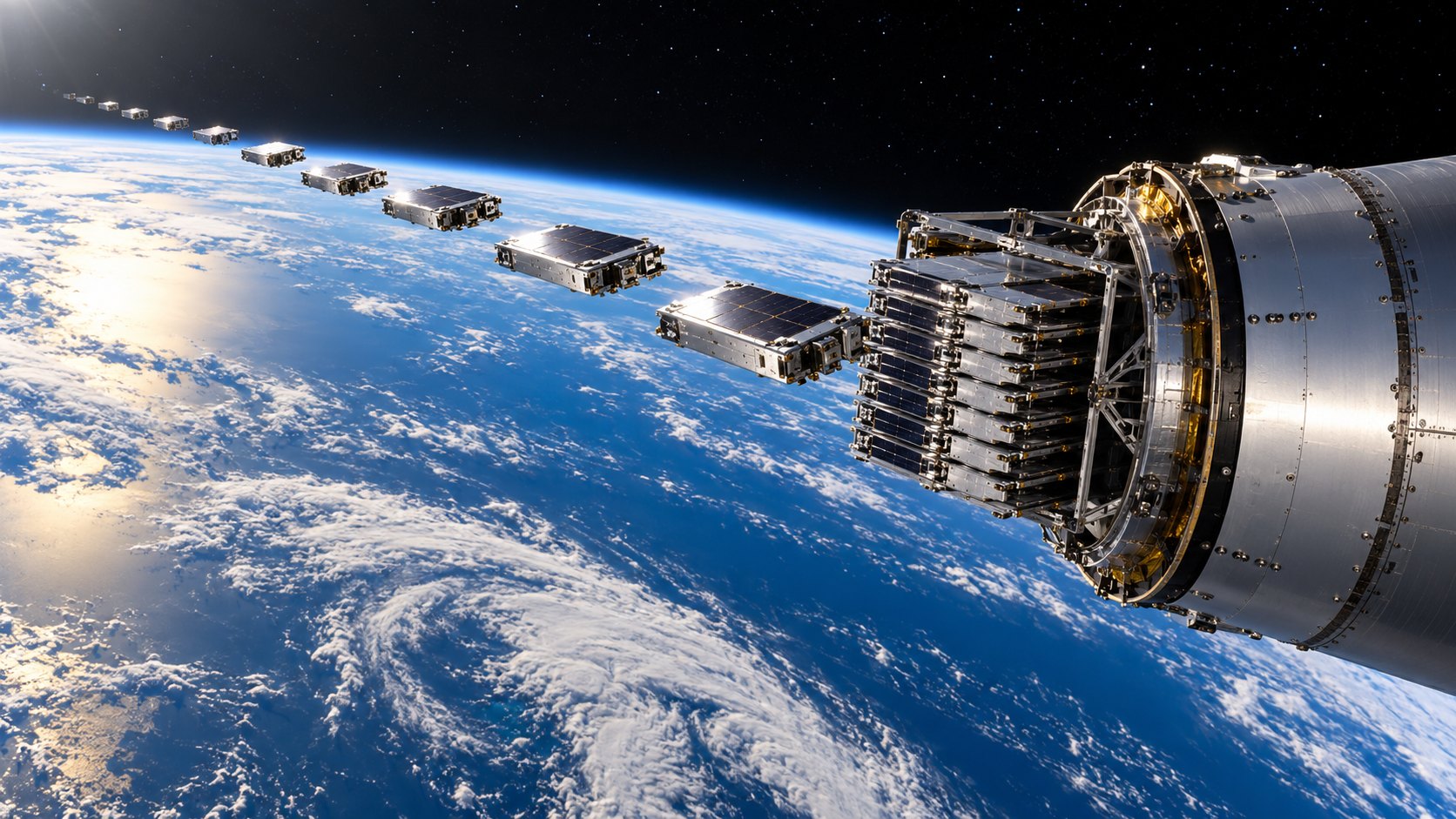
You make them flat and stack them like a deck of cards. Each first-generation Starlink satellite was a flat panel about the size of an office desk, weighing about 227 kilograms. It carried four flat phased-array antennas, a single solar array that unfolds in space, and a small thruster that runs on krypton gas. Laid on top of each other, sixty of them filled the nose cone of a Falcon 9 from bottom to top.
Together they weighed 13,620 kilograms, the heaviest payload SpaceX had ever launched. Musk called it a tight fit. What was missing mattered just as much: there were no deployment mechanisms between the satellites at all. That saved mass and parts, but it left an obvious problem. Without springs to push them away, sixty loose satellites could easily bump into each other.
How do satellites leave a rocket without springs?
The rocket spins, lets go of the whole stack, and physics spreads the cards. After two delays, one for high winds and one for a software update, the Falcon 9 lifted off from Cape Canaveral on 23 May 2019 at 10:30 p.m. local time. The booster, already on its third flight, landed on a drone ship in the Atlantic. About an hour after liftoff, at an altitude of roughly 440 kilometres, the upper stage started a slow spin and released all 60 satellites as one clump.
Because each satellite sat at a different place in the spinning stack, each one moved off at a slightly different speed and slowly drifted away from its neighbours. Before the launch, Musk described it as "almost like spreading a deck of cards on a table." Then the satellites were meant to unfold their solar panels and use their krypton thrusters to climb to 550 kilometres. Nobody could be sure that sixty brand-new satellites would all wake up.
What happened to the first 60 satellites?
Most of them worked, three failed, and the whole world saw them. The very next night, satellite tracker Marco Langbroek in Leiden, in the Netherlands, filmed a straight line of bright dots crossing the sky. He counted at least 56 of them and said he shouted out loud in surprise. Videos of the "Starlink train" went around the world, and astronomers began to worry about what thousands of such satellites would do to their view of the stars.
By the end of June, SpaceX reported that 45 satellites had reached their working orbit and others were still climbing. Three had stopped responding and would fall back and burn up on their own. Two working ones were brought down on purpose, to prove that a Starlink satellite can steer itself out of orbit. Musk had warned that some might fail; these were test versions, without the laser links later satellites would get. The method itself, though, had worked, and it now had to work hundreds of times.
Why does a deck of cards in orbit still matter?
Because the stack became the production line of the largest satellite network ever built. In November 2019 the first operational batch of 60 followed, and through 2020 and 2021 Falcon 9 launched one stack after another. A Falcon 9 now carries around two dozen of the larger V2 Mini satellites per flight, and Starlink passed 10,000 satellites in orbit at the same time in 2026. Starship takes the idea further: its 26 V3 satellites on Flight 14 added about ten times the capacity of a Falcon 9 load, according to SpaceX. Flight 15 is next.
For Tesla, Starlink is no longer distant space news. Its dishes already connect remote Superchargers, the Cybercab has been shown with a built-in Starlink antenna, and Tesla and SpaceX are studying a possible merger. The lesson of 2019 is one Tesla fans will recognise from the factory floor: build it simpler, launch it sooner, and fix what breaks on the next batch. Sixty satellites, stacked like cards, are where that bet in space began.
Sources (4)
- Reuters via The Christian Science Monitor: Under pressure from Musk, SpaceX hustles to launch satellites
- Spaceflight Now: SpaceX's first 60 Starlink broadband satellites deployed in orbit
- EarthSky: Wow! Photo and video of SpaceX Starlink satellite train
- Space.com: Contact lost with three Starlink satellites, other 57 healthy
Images are illustrations; some are made with AI.