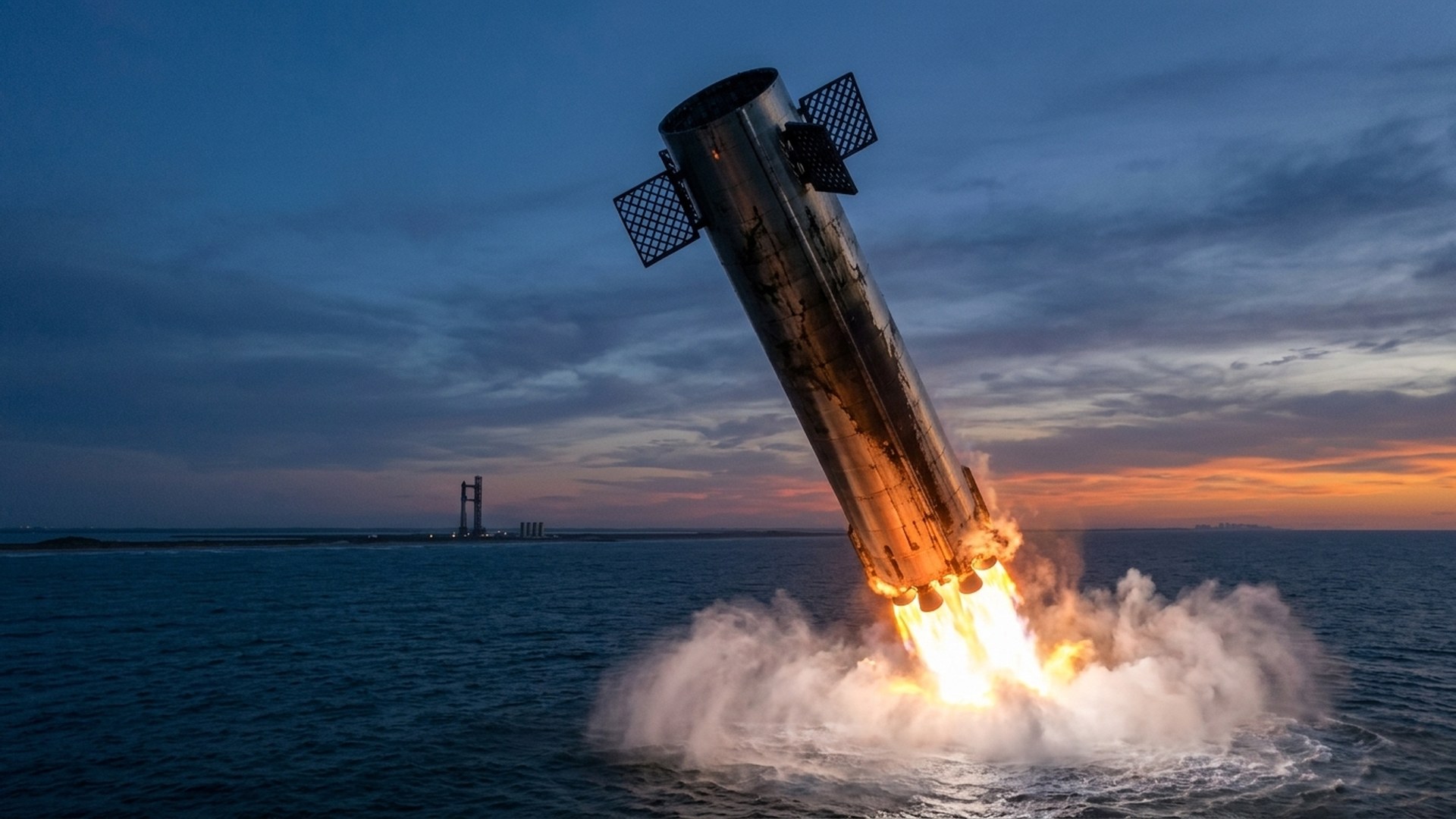
Catching the ship takes about 22 hours
On Flight 15 SpaceX plans to catch the Super Heavy booster after about 6.5 minutes and the ship about 22.5 hours later, at the same tower. Here is why the ship has to wait almost a whole day.
On Starship Flight 15, SpaceX plans to catch both halves of the world's biggest rocket with the same tower arms. The Super Heavy booster is due back about six and a half minutes after liftoff. The upper stage, called Ship, is due back at the same tower about 22 and a half hours later. Same pad, same arms, yet one half comes home almost a full day after the other. That gap has nothing to do with caution, and everything to do with something the ship cannot control.
Why can the booster come straight back?
Because it never reaches orbit. Super Heavy burns for about two minutes and 19 seconds, then the ship lights its own engines and pulls away in a hot-staging separation. Just five seconds later the booster starts its boostback burn: its engines fire for about 36 seconds and turn its path from heading out over the Gulf of Mexico to heading back towards Texas. It then falls, steers with its grid fins and lights its engines once more to slow into the reach of the tower arms, about six minutes and 35 seconds after liftoff.
This part has been done before. SpaceX has caught a first-generation Super Heavy three times, on Flights 5, 7 and 8, and two of those boosters flew again. Flight 15's Booster 22 is the first of the bigger third-generation boosters to try. The booster can make this U-turn because it is still well below orbital speed. The ship does not have that luxury.
So what makes the ship so different?
It is in orbit, and an orbit cannot simply be reversed. After about eight minutes the ship is circling the Earth at roughly 275 kilometres up. At that height, basic orbital physics gives a speed of about 7.7 kilometres per second, close to 28,000 km/h, and one lap of the planet takes about 90 minutes. NASA gives the same 90 to 93 minutes for the International Space Station.
At that speed there is no turning around. The only way down is to fire the engines against the direction of travel, so the lowest point of the orbit dips into the atmosphere, and then let the air do most of the braking. That fall takes the better part of an hour, so the ship has to start its way home far from Texas, on a path that ends exactly at the tower. And Texas does not stay where the ship left it.
Why does Starbase drift away from the ship's path?
Because the Earth turns under the orbit. An orbit stays roughly fixed in space, while the planet rotates once a day beneath it. NASA's orbit tutorial puts it plainly: each lap of the space station shifts its track over the ground about 22.9 degrees of longitude to the west. For Starship's orbit the shift is about the same. At Starbase's latitude, around 26 degrees north, that is more than 2,000 kilometres per lap.
So after every lap the ship's path passes further west of Texas. The ship can only aim for the tower once the Earth has turned Starbase back under a path that ends there. In SpaceX's published timeline that moment comes after about 14 orbits, which at 90 minutes a lap is roughly 21 hours. That leaves almost a whole day to fill.
So how does SpaceX use the 22 hours?
For work, and for checking that a landing is safe. Starting about 35 minutes after liftoff, the ship releases 26 Starlink V3 satellites. Three of them carry cameras to photograph the ship's heat shield and send the images down, one of several sources SpaceX uses to decide whether the ship is fit to come home.
The timeline also has three return checks, with splashdown zones off Hawaii and Chile as the way out. If the team is not sure that the systems needed for re-entry, the landing burn and the tower approach are healthy, the ship does not head for Texas. It comes down in the ocean instead. And even a healthy ship still has one hard hour ahead.
What happens in the last hour?
One short burn, a long fall and a few busy seconds. At about 21 hours and 36 minutes the ship fires its engines for only about ten seconds. That is enough to bend its path into the atmosphere. Some 35 minutes later it hits the thick air, belly first, with its heat shield facing down, and falls for another 20 minutes.
Near the ground the landing burn starts. The ship swings upright, its engines throttle from three to two to one, and at about 22 hours and 32 minutes it should come to a stop between the arms. From the ten-second burn to the catch: about 57 minutes. The burn happens almost half a world away because the ship needs that long to fall home. Getting it back in one piece would change what a rocket is.
Why does catching both halves matter?
Because it would mean the whole rocket comes back to be flown again. Elon Musk wrote that a double success would "mark the first time that all parts of an orbital rocket return to Earth intact". He called the odds "more likely than not", a forecast, not a result. Falcon 9 already lands its booster, but its upper stage burns up after every flight.
A ship caught at the tower would be back where it started, ready to fly again, like an aircraft. That is the whole point of Starship. It also explains the odd timetable. The booster is home in minutes because it never leaves the neighbourhood. The ship has to wait for the planet to bring the neighbourhood back.
Sources (4)
Images are illustrations; some are made with AI.