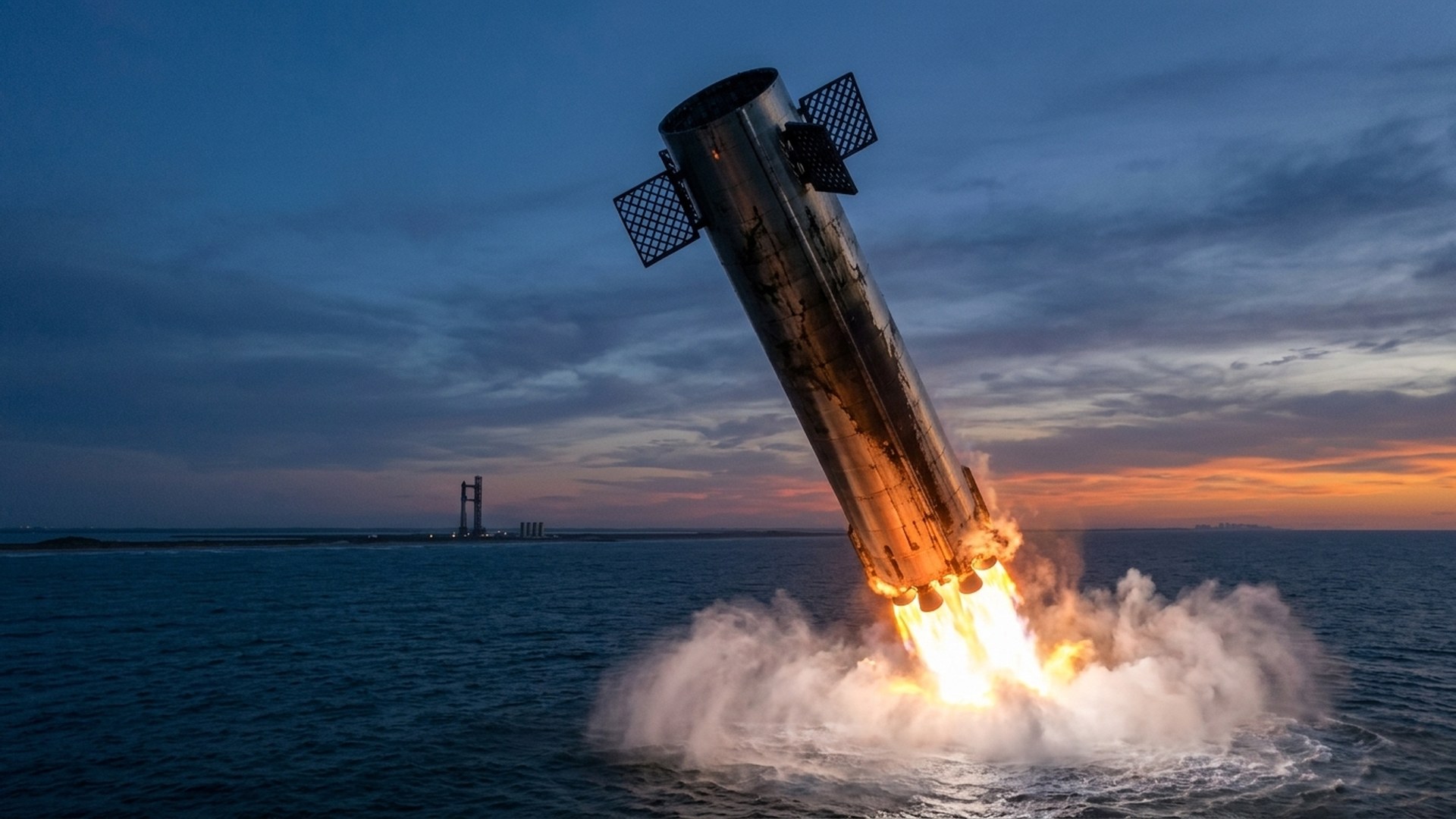
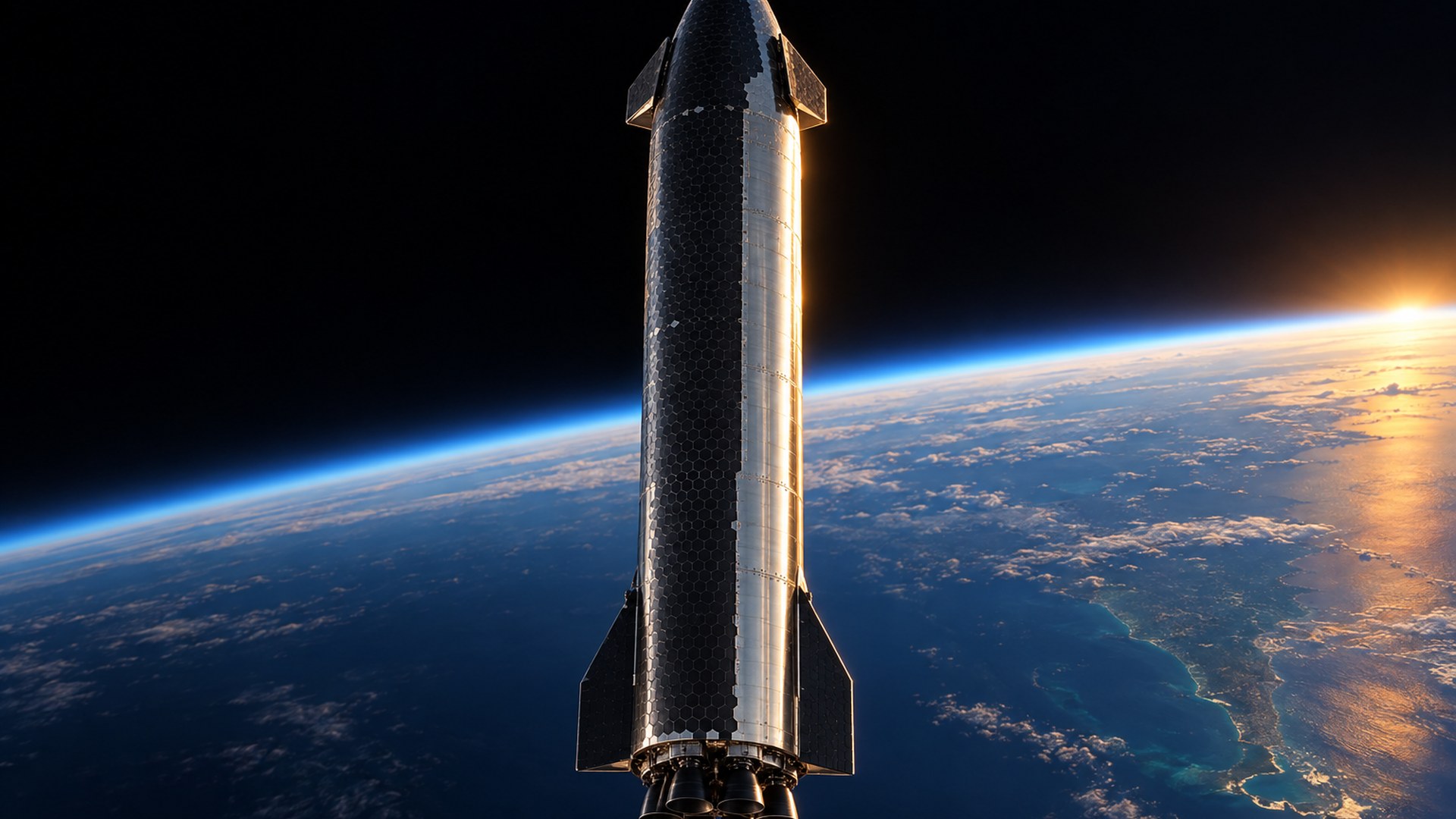
Starship fires its engines at its own booster
Starship lights its six engines while it is still attached to the Super Heavy booster. Here is how hot staging works, why it adds payload, who did it first and what it means for catching both stages.
On Starship Flight 15, planned for November 2026, SpaceX wants to catch both halves of its giant rocket with the launch tower for the first time: the Super Heavy booster and the ship on top. Before either catch can happen, the two halves have to part ways, roughly two and a half minutes after liftoff and high above the Gulf of Mexico. The way they do that looks like a mistake. The ship lights its own engines while it is still sitting on the booster, so its flames blast straight down onto the stage below. That booster has 33 engines and tanks that held thousands of tonnes of methane and liquid oxygen a moment earlier. Firing rocket engines into another rocket sounds like the quickest way to destroy both.
What is hot staging, and how does Starship do it?
Hot staging means the upper stage starts its engines before it lets go of the stage below. Most rockets do it the other way round, which engineers call cold staging: the first stage shuts down, the stages are pushed apart, there is a short coast, and only then does the upper engine light.
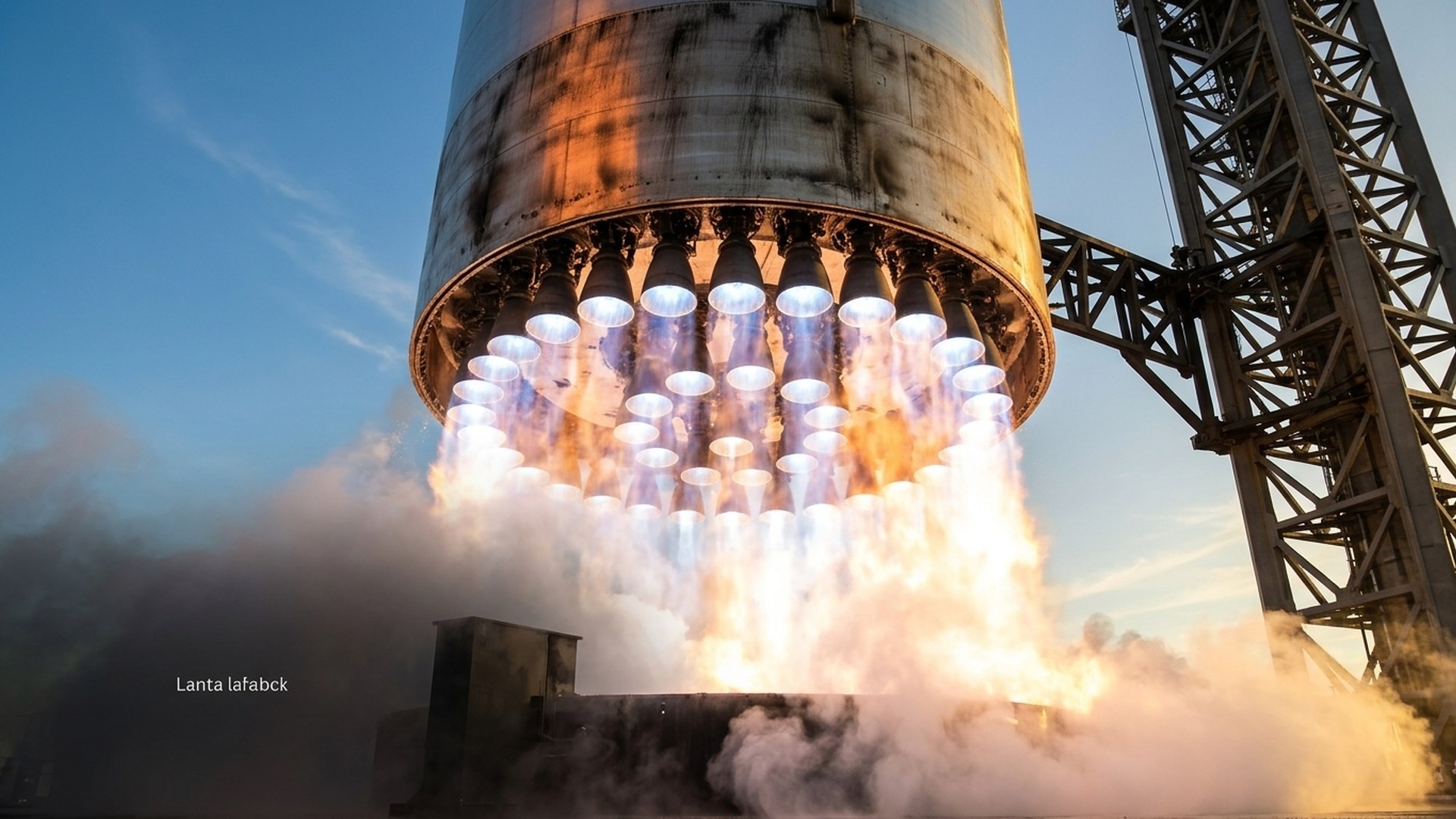
Starship reverses that order. Near the end of its burn, Super Heavy powers down all but three of its 33 Raptor engines. The ship then ignites its six Raptors while it is still attached, and their thrust pushes it off the booster. All that fire needs a way out, so a short section on top of the booster, the hot stage ring, is full of openings that let the exhaust escape sideways. The ring also works as a shield for the top of the booster's tank.
Building an armoured, vented ring into a rocket adds weight, and weight is the one thing rocket engineers fight hardest.
So why would SpaceX choose the harder way?
Because a rocket that stops pushing, even for a few seconds, starts losing speed to gravity. In cold staging there is a gap where no engine is firing. The rocket is still climbing, but gravity keeps pulling it back, and every metre per second lost has to be won back later with extra fuel.
There is a second, less obvious problem. Without thrust, the liquid propellant in the upper stage's tanks starts to float away from the drains at the bottom. Engines need liquid, not gas bubbles, at the moment they start. Many cold-staged rockets fire small extra thrusters first, just to settle the propellant. In hot staging the vehicle never stops accelerating, so the propellant stays where the engines need it.
- No coast: no unpowered seconds, so less speed lost to gravity.
- Settled propellant: the ship's engines start with fuel already pressed against the drains.
- More payload: Musk estimated the gain at about 10% more mass to orbit. That is his estimate, not a published measurement.
- A head start home: the push from the ship's exhaust helps start the booster's flip for its return.
The idea sounds daring, yet SpaceX did not invent it.
Who used hot staging before Starship?
Rocket builders have been doing it since the 1960s. The best-known American example is the Titan II, the missile NASA used to launch its two-person Gemini capsules between 1964 and 1966. Its second-stage engine fired while the stages were still joined, and the gases escaped through sixteen rectangular ports near the joint. From a distance it looked as if a slice of the rocket was missing.
Russian rockets have hot staged for decades too. You can often spot them by the open lattice frame between two stages, which leaves room for the upper engine's flames.
What is new is the size. When it worked on Starship for the first time, SpaceX called it the first successful hot staging of a vehicle this large. Getting there was anything but smooth.
How did Starship learn to hot stage?
It was a late change, made after the stages on the first flight refused to come apart. On Flight 1 in April 2023, the booster and ship never separated as planned. SpaceX redesigned the separation, and Musk described the new booster extension as almost entirely vents.
On Flight 2, on November 18, 2023, it worked: the booster throttled down, all six ship engines lit, and the ship flew on to space. The booster broke apart shortly afterwards during its return burn, but the staging itself had done its job, and it has been part of every flight since.
The ring kept evolving. On the second-generation Starship it was a separate piece that dropped away and fell into the sea. On the third generation, which flies Flight 15, the ring is fixed to the top of the booster and stays with it. The new booster also has three grid fins instead of four, each about half as large again, mounted lower to keep them out of the staging heat.
That last change matters for the boldest part of Flight 15.
What does hot staging mean for catching both stages?
Every catch starts with a clean separation, and a ring that stays on the booster is one less part thrown away. After staging, the booster flips, fires its engines to head back, and is meant to be caught by the tower within minutes of liftoff. So by the time the ship comes home, its booster is already back at the tower. The ship carries on to orbit and still has to survive re-entry before its own catch attempt, a first for any Starship.
Musk has put the chance of catching the ship on the first try at around 50 to 60 percent. For Tesla fans, it is more than a space story: Tesla and SpaceX have set up special committees to study a possible merger, and a fully reusable Starship is one of the biggest drivers of SpaceX's value.
So the next time you watch a Starship launch, keep an eye on the moment about two and a half minutes in. The flash between the two stages is not an explosion. It is the ship pushing off.
The flight table is on all Starship flights. How the ship comes back without wings is in the catch with no wings and no legs. Both rocket families sit on SpaceX.
Sources (4)
- Space.com: Epic 33-engine burn among successes of Starship's 2nd test flight, SpaceX says
- Space.com: How SpaceX's new Starship 'V3' differs from its predecessors
- Popular Science: Why were there holes in the Titan rocket that launched NASA's Gemini missions?
- Space.com: SpaceX's Starship design changes ahead of its second test flight
Images are illustrations; some are made with AI.