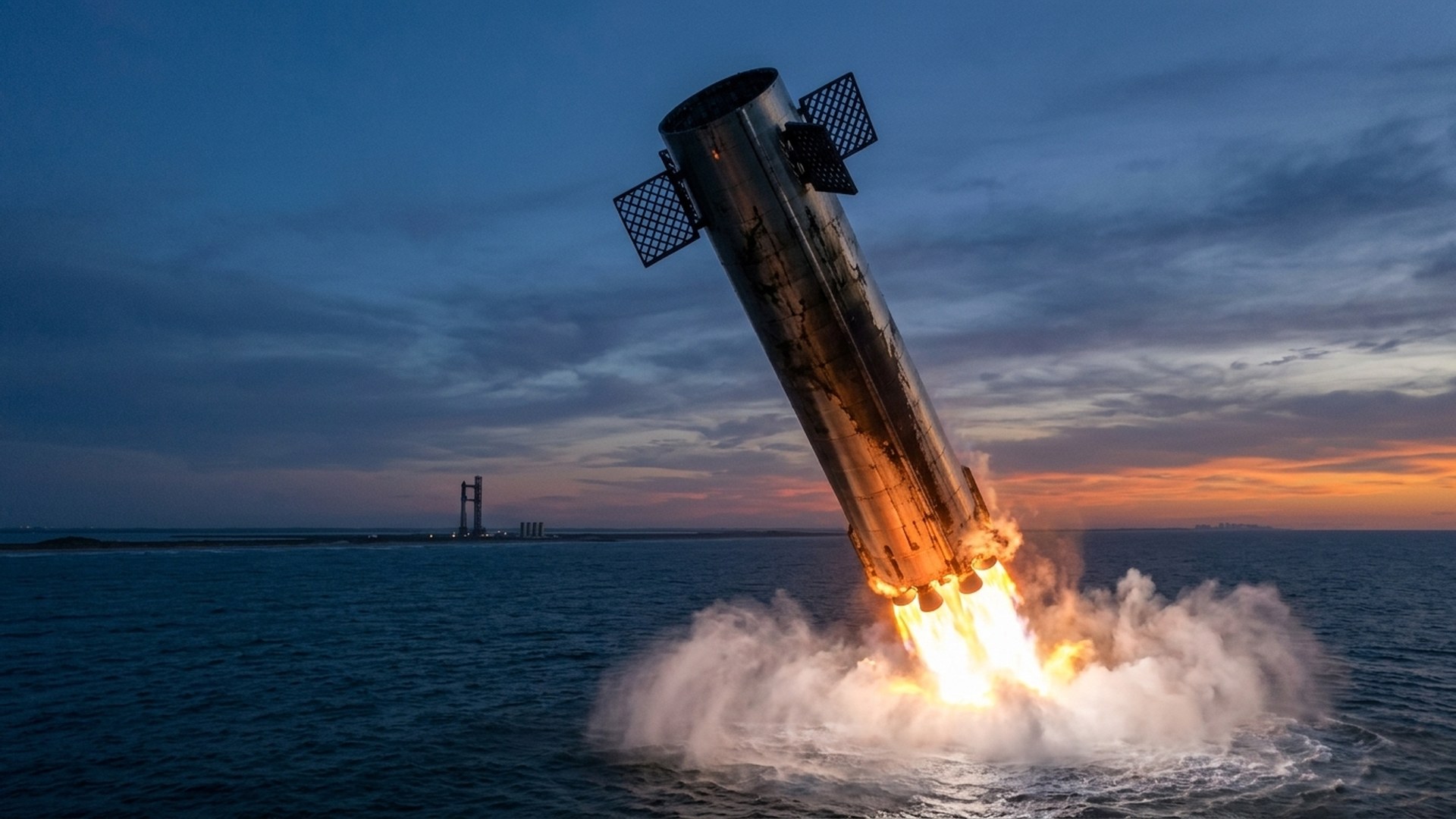
Super Heavy does not return after a splashdown
Starship's Super Heavy booster can hover gently over the Gulf, yet every one that went into the sea was lost. Here is what happens after splashdown, and why only a tower catch brings a booster back.
On Starship Flight 15, Super Heavy Booster 22 did almost everything right at the very end. It fired its landing burn, slowed to a hover a few feet above the Gulf of Mexico, and shut down its engines. Then its flight termination system went off and the booster blew apart just above the water, about six and a half minutes after liftoff on 13 November 2026. As it resurfaced, its leftover propellant burned on the sea. It looked like a failure, but every Super Heavy that has gone into the sea has ended the same way. No booster that splashed down has ever flown again, and the reason lies in what the sea does to a rocket built to be caught.
What happened to Booster 22 on Flight 15?
It was sent to the sea by its own guidance system, then destroyed itself just above the water after a controlled hover. The plan was to bring Booster 22 back to the tower at Starbase for the first catch of the new, bigger Version 3 booster. After separation it lit 32 of its 33 engines for the boostback burn. Then the guidance system "detected that the booster was not in the place that it was supposed to be to proceed with a catch," SpaceX's Dan Huot said, and triggered an automated abort. He added that the system "was doing what it was supposed to do." SpaceX is still looking for the root cause.
Over the Gulf, the booster lit 13 engines for its landing burn, hovered and cut its engines. Then the flight termination system fired, and the booster exploded a few feet above the sea. A gentle landing on water does not save a booster either.
Why doesn't a soft splashdown save the booster?
Because Super Heavy has no legs: it can stand on its engines while they burn, but once they stop, nothing holds a 70-metre steel tube upright. SpaceX proved it could put a booster down gently long before Flight 15. On Flight 4, on 6 June 2024, Booster 11 made the first soft, vertical splashdown in the Gulf. Elon Musk wrote that the next landing would be "caught by the tower arms." The landing itself worked. Afterwards the booster went over into the water, and a photo of the engine section that Musk later posted showed it badly mangled.
Flight 6, in November 2024, went the same way. Its booster was meant to be caught, was diverted to the Gulf, and settled into a vertical, low-speed splashdown just off the shore at Boca Chica. Soon after, a fireball rose from it. A booster arrives with fuel left in its tanks and very hot engines, and a tall, nearly empty tank that falls into the waves does not stay in one piece. The wreck then disappears from view.
So where does a booster go after it breaks up?
Mostly to the bottom of the Gulf, and only rarely does a piece come back up. Booster 11 sank to the seafloor about 55 metres down. Months later SpaceX hired the HOS Ridgewind, a subsea service vessel from the offshore industry, to bring the wreck up. In September 2024 Musk posted a photo captioned "Starship Super Heavy Booster Flight 4": the engine section, twisted and torn. The rest of the giant booster, too big to lift, stayed below.
That is an expensive way to get back a set of broken engines. The engines cannot fly again, but they show how the booster came apart. It explains why SpaceX keeps sending boosters to the sea.
Why does SpaceX still send boosters to the sea?
Because the sea is the safe fallback: a lost booster costs one rocket, a booster that hits the tower can cost the whole launch site. Every Super Heavy is set up to end in the Gulf unless its catch is approved by both the automated checks and the flight director. The same tower that catches the booster also launches the rockets, so when anything looks wrong, the booster goes to the water. Flight 15 showed that rule working: the guidance system did not like what it saw, and the booster turned away.
A splashdown is still a test. The boostback, the flip and the landing burn all happen over open water, so SpaceX gets the data without risking the pad. What it does not get back is the booster itself. That leaves one route home.
So what does it take for a booster to fly again?
A catch: only boosters the tower has caught have ever flown a second time. The tower's arms caught Super Heavy on Flights 5, 7 and 8, the first time in October 2024. Booster 14, caught on Flight 7 in January 2025, became the first Super Heavy to fly again, on Flight 9. That is the whole point of the arms. A booster that is caught goes back to the hangar, gets checked and flies again. A booster that goes to the sea ends as a fireball, a wreck on the seafloor or a few engines on the deck of a hired ship.
Version 3 has not yet made a successful return to the tower. Until it does, every splashdown in the Gulf ends the same way. The sea can test a booster. Only the tower can give it back.
Sources (4)
- Space.com — SpaceX still investigating why Starship Flight 15 booster aborted 'chopsticks' catch
- Spaceflight Now — Starship in orbit ahead of catch attempt, booster diverts to explosive splashdown
- Spaceflight Now — Super Heavy-Starship launches on sixth test flight, skips tower catch
- Space Explored — SpaceX recovers the Super Heavy booster from Flight 4
Images are illustrations; some are made with AI.