The Cybertruck broke its own window
From a cracked window on stage in 2019 to the end of production at Giga Texas: the story of the stainless steel bet behind the Cybertruck, what it cost Tesla and what it leaves behind.
On 6 November 2026, Elon Musk posted that Tesla will be "winding down production of the Cybertruck at Gigafactory Texas around the middle of next year to make room for increased Cybercab production." Giga Texas is the only plant that builds the truck. Kelley Blue Book estimates that about 71,000 Cybertrucks have been sold since the 2023 launch, while Musk once spoke of 250,000 to 500,000 a year. The ending is modest. The truck itself never was, and almost everything about its story, from its shape to its troubles, traces back to one bet on a slab of steel.
Why did a pickup truck look like a stealth fighter?
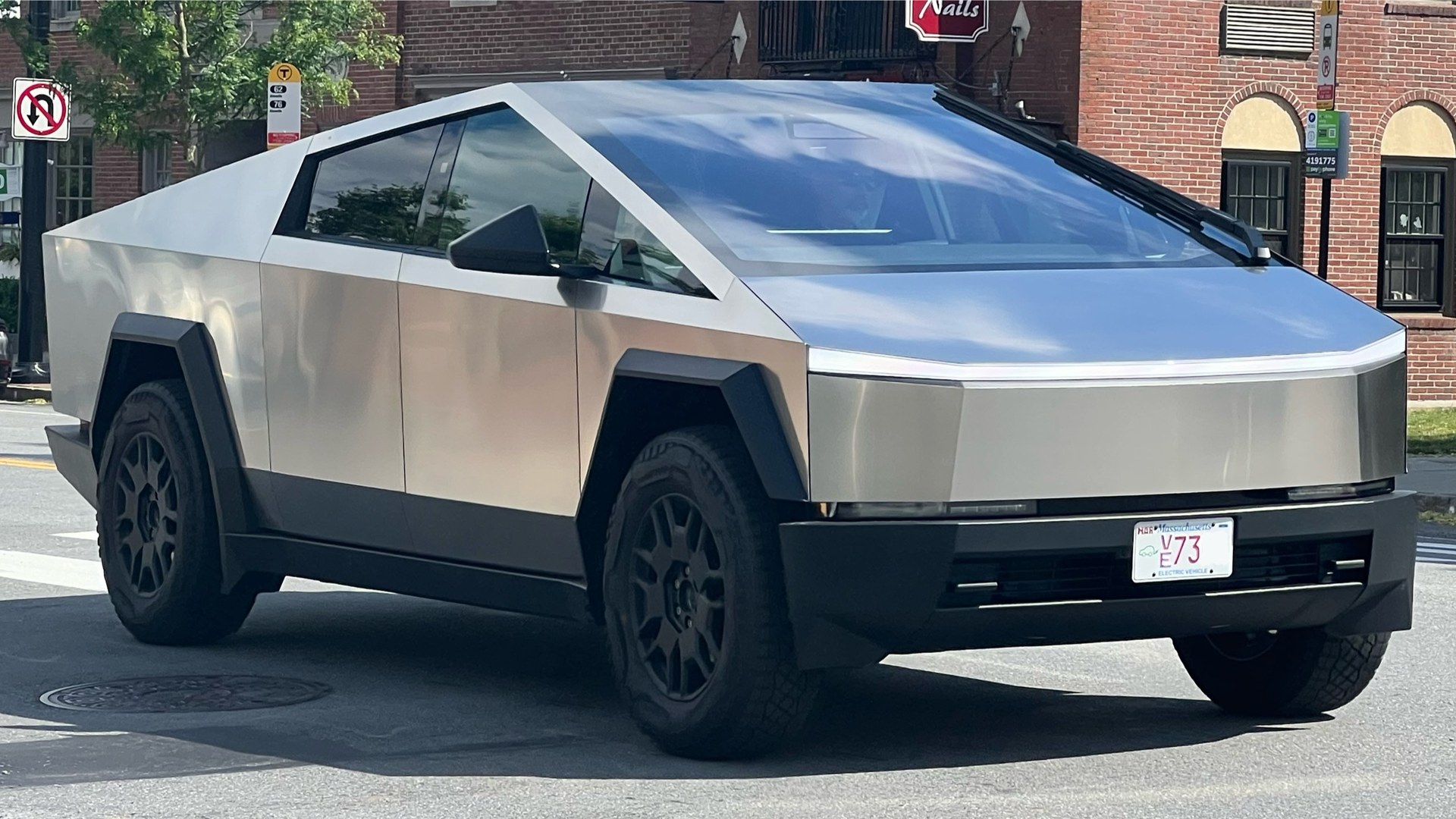
Because Musk wanted a truck that looked like the future, not like every other pickup. He named two inspirations: the film Blade Runner and "Wet Nellie", the white Lotus Esprit that turns into a submarine in the 1977 James Bond film The Spy Who Loved Me. Musk had bought that very movie car at auction in 2013, for close to a million dollars. Tesla's chief designer Franz von Holzhausen turned the idea into an "exoskeleton": a hard outer shell that carries the load, with a deliberately low-resolution look of flat faces and sharp edges.
A full-size clay model followed, and it looked like nothing else on the road. But the shape was not only a matter of taste. The material made the decision too.
So why is it made of flat stainless steel?
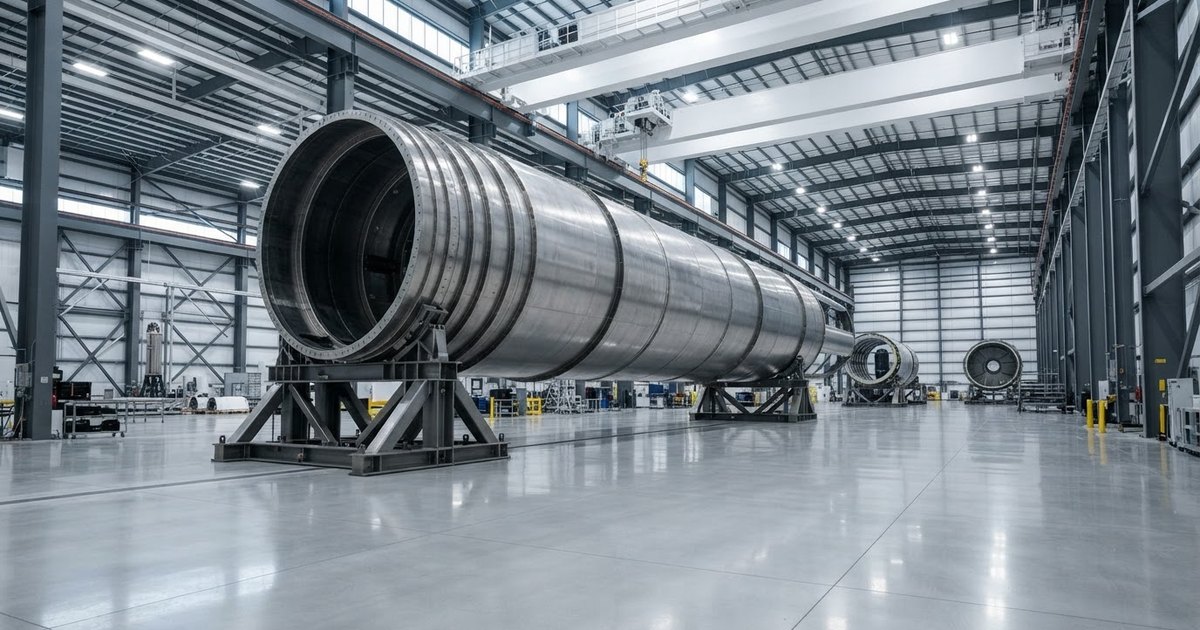
Because the steel Tesla chose is too hard to press into curves. At the reveal, Musk said the truck would use the same cold-rolled stainless steel alloy as SpaceX's Starship rocket, then being built in Texas. Ordinary car bodies are stamped: a press squeezes thin sheet metal into a curved mould. Musk explained on X that you can't stamp ultra-hard 30X steel "because it breaks the stamping press."
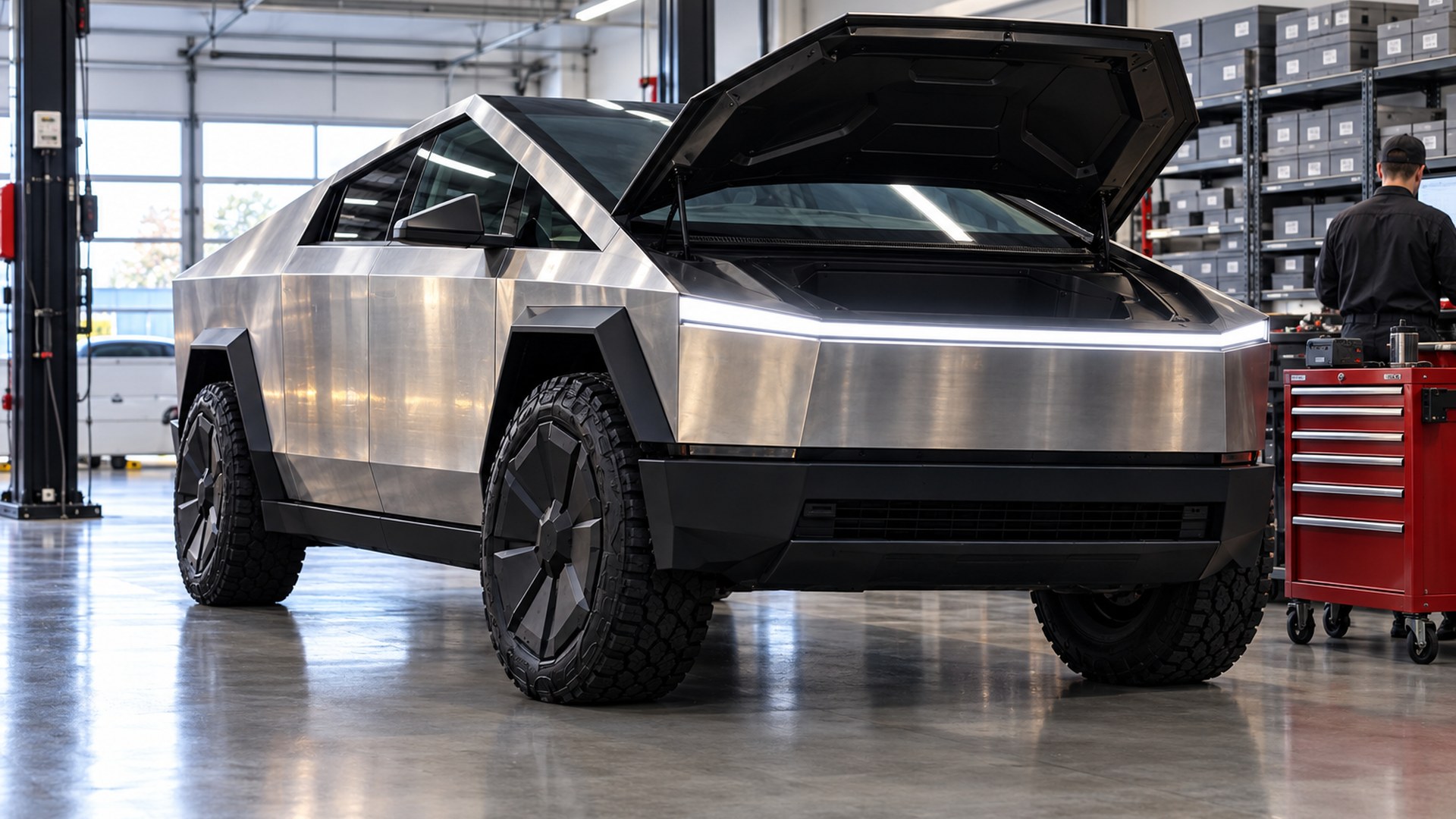
So the panels are laser-cut and bent along straight lines, and Tesla developed an "air bending" method that shapes the steel with high-pressure air. The body panels are about 1.4 mm thick, the doors 1.8 mm. There is no paint shop: the bare steel is the finish. Flat panels, straight folds, no paint. It was a bold way to make a car simpler, and Tesla wanted to prove how tough it was, live on stage.
What happened on the night the window broke?
The toughness demo worked on the door and failed on the glass. On 21 November 2019, at Tesla's design studio in Hawthorne, California, next to SpaceX's headquarters, von Holzhausen hit the door with a sledgehammer. No dent. Then he threw a metal ball at the "Armor Glass" front side window, which Tesla had called nearly unbreakable. It cracked. He threw again at the rear window. That one cracked too, with the world watching.
Musk later said the sledgehammer blow had cracked the base of the glass before the throw. Tesla's shares fell about 6% the next day. Yet within five days Musk reported 250,000 pre-orders, each with a refundable $100 deposit. Interest was enormous. Building the thing turned out to be a different matter.
Why did it take four years to reach customers?
Because a truck that breaks the usual rules also breaks the usual factory. The first deliveries were meant for late 2021. That slipped to 2022 and then to late 2023, as Tesla wrestled with the final design, the huge stainless panels and the pandemic. On the October 2023 earnings call, Musk was blunt: "we dug our own grave with Cybertruck." Special products like this, he said, are incredibly hard to bring to volume.
The first trucks were handed over at Giga Texas on 30 November 2023, about a dozen of them. The promises had changed on the way. In 2019 Musk had announced a starting price of $39,900 and up to 500 miles of range. At launch, the cheapest version was listed at $60,990, the dual-motor truck at $79,990 with 340 miles, and the Cyberbeast at $99,990. Then came recalls, among them a sticky accelerator pedal in 2024, an exterior trim panel whose glue could fail in 2025 and a light bar that could come loose. Every one had to be fixed on a truck that customers had waited years for.
So did the steel bet pay off?
As a product, it fell far short of its promise; as a test bench, it delivered. In 2024, its first full year, about 38,965 Cybertrucks were sold according to Kelley Blue Book, making it America's best-selling electric pickup that year. Then sales dropped. In early 2025 the Ford F-150 Lightning took the title back, and in the third quarter of 2026 Tesla sold 8,295. Tesla had said in 2023 that its capacity exceeded 125,000 trucks a year. A price cut for the dual-motor version to $59,990 in February 2026 did not bring sales anywhere near that.
Under the steel skin, though, the Cybertruck carried ideas no Tesla had before. A 48-volt electrical system instead of the old 12 volts. Steer-by-wire, with no mechanical link between the wheel and the front wheels, plus rear-wheel steering. And a new network called Etherloop that cut the wiring across the vehicle by two-thirds compared with the Model 3. Cybertruck lead engineer Wes Morrill called it a technology development platform that lives on through the Cybercab. That leaves one question: what remains when the line stops.
What does the Cybertruck leave behind?
A fleet on the road, a factory floor for robotaxis and a lesson in how far a design bet can carry a car. Musk added that the Cybertruck fleet will be around for a long time, and he did not say whether production will stop completely. Earlier in 2026, Tesla also ended the Model S and Model X, with Musk saying the Fremont space was needed for Optimus robot lines. The pattern is clear: Tesla is moving floor space from human-driven cars to the Cybercab and the robot.
In our view, the Cybertruck is two stories at once. One is about overpromising: a price that rose by more than half, a range that shrank and a demand forecast that missed by a wide margin. The other is about daring to build differently: stainless steel without paint, a body that is also the frame, and electronics that now live on in other vehicles. It may be remembered less for how many were sold than for the night its window cracked and everyone still wanted one.
The model page is Cybertruck. What remains when Tesla stops building a vehicle is in cars Tesla no longer makes.
Sources (5)
- Forbes: Musk says Tesla will wind down Cybertruck production next year to make room for Cybercab
- Yahoo Finance: Musk bids farewell to Cybertruck as Tesla bets on robots and self-driving
- Equipment World: Cybertruck's flat-panel design necessary, Musk says, as pre-orders climb to 250K
- Popular Science: Elon Musk says 'we dug our own grave with Cybertruck'
- Wikipedia: Tesla Cybertruck
Images are illustrations; some are made with AI.