A tent saved Tesla from production hell
In June 2018, close to running out of money, Tesla built a whole Model 3 assembly line in a tent on its parking lot. How it happened, whether it worked, and why it still shapes how Tesla builds cars.
In November 2026, drone footage of Giga Texas suggested that Tesla is moving the plant to round-the-clock production: two 12-hour shifts instead of one day shift, and no long shutdowns around Thanksgiving and Christmas. Tesla has not confirmed it. But Tesla has pushed a factory to its limit before, and that time the company itself was on the line. In June 2018, with money running out, Tesla built a complete car assembly line inside a giant tent on the parking lot of its Fremont factory. The car it had to save was the Model 3, the affordable Tesla that was supposed to turn a niche brand into a mass-market carmaker. A year after its launch, the factory could barely build it.
Why was the Model 3 so hard to build?
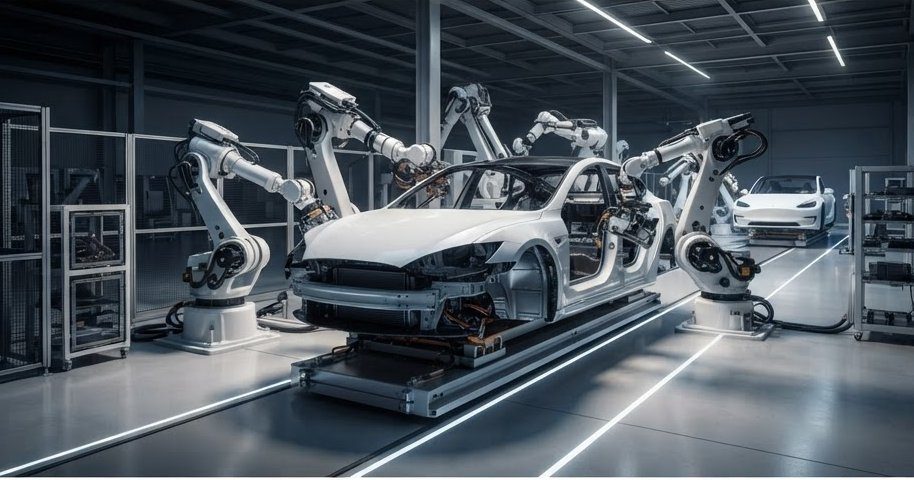
Because Tesla tried to automate almost everything at once, on a brand-new car. The first 30 Model 3s were handed over to employees in Fremont in July 2017, and at that event Elon Musk warned of "at least six months of manufacturing hell". He had tweeted that Tesla would build more than 1,500 Model 3s in September and reach 20,000 a month by December. Reality was harsher: from July to the end of September 2017, Tesla built just 260 of them. Tesla blamed "production bottlenecks", and much of the trouble sat in the highly automated assembly in Fremont.
In April 2018 Musk told CBS that Tesla had built a "crazy complex network of conveyor belts" that did not work, and that the company had thrown it out. A few hours later he went further on Twitter: "Yes, excessive automation at Tesla was a mistake. To be precise, my mistake. Humans are underrated." In the first quarter of 2018 Tesla made 9,766 Model 3s, roughly 750 a week on average, while hundreds of thousands of reservation holders were waiting. Every slow week cost money Tesla did not have.
How close did Tesla come to running out of money?
Within "single-digit weeks", according to Musk himself. In an interview with Axios on HBO in November 2018, he said the company had been "bleeding money like crazy" during the ramp, and that it would have died if the problems were not solved in a very short time. He described weeks of up to 120 hours of work, and said he sometimes slept at the factory.
The fix was not only fewer robots. Tesla stopped lines to rework them, added people and pulled every trick to get more cars out of the same building. Musk had set a clear target: 5,000 Model 3s in one week by the end of June 2018. The trouble was that the Fremont factory, a former GM and Toyota plant, had no room left for another assembly line.
So where do you put a new assembly line in a few weeks?
Outside, under canvas. On 7 June 2018 Tesla applied for a building permit for a large tent next to the factory's paint shop; the city issued it on 13 June. On 16 June Musk announced on Twitter that Tesla had a new general assembly line, called GA4. According to Musk, the team built it in about three weeks, with minimal resources, partly from parts that were lying around the plant. The structure, made by the tent company Sprung, covered 137,250 square feet, roughly two football fields. It had no air conditioning, and the permits called it "temporary".
Car-industry veterans were stunned. "Words fail me. It's insanity," Bernstein analyst Max Warburton told Fortune. The new line started almost entirely manual: people instead of robots. Within days, it would have to prove itself.
Did the tent actually work?
Yes: Tesla hit 5,031 Model 3s in the last seven days of June, and about one in five came from the tent. On 1 July 2018 Musk tweeted "7000 cars, 7 days", counting the 1,913 Model S and Model X built in the same stretch. In its official report Tesla said the quality from GA4 was "as good as our regular GA3 line". Over the whole second quarter, Tesla built 28,578 Model 3s, more than all its Model S and Model X combined, for the first time.
It was a sprint, not yet a steady pace. Critics pointed out that one record week is not the same as a factory that runs smoothly, and Tesla immediately set a new goal of 6,000 a week. But the deadline that seemed impossible had been met, with a production line that most carmakers would never have dared to build. And the lesson of that summer outlasted the tent itself.
Why does the tent still matter for Tesla today?
Because it taught Tesla that a factory is a product you keep redesigning, not a building you finish. This is our reading of the story: since 2018, Tesla's biggest bets have been about how cars are made as much as about the cars themselves. Giant one-piece castings replaced dozens of stamped parts in the Model Y, and the Cybercab is built with the "unboxed" process, in which big sections are assembled separately and joined at the end. Each of those ideas, like GA4, came from asking which steps can simply be removed.
The tent also shows the other side of Tesla. Its deadlines slip, the pressure on workers was real, and a near-death experience is not a business model. Musk's own lesson from 2018, that humans are underrated, sounds different now that Tesla also builds Optimus, a humanoid robot meant to do factory work itself. If Giga Texas really runs day and night, it is the same idea at a far bigger scale: the factory is the machine. In 2018, that machine started in a tent.
Sources (5)
- Teslarati: Tesla Giga Texas reportedly moves to 24/7 production
- Fortune: Elon Musk's Tesla is building Model 3s in a tent (June 2018)
- TechCrunch: Tesla built 20% of last week's Model 3s in its fancy new tent
- Fortune: Elon Musk says 'humans are underrated' after Model 3 automation problems
- Axios: Elon Musk says Tesla came within single-digit weeks of death
Images are illustrations; some are made with AI.