Six stations grew into 85000 plugs
In 2012 Tesla opened six solar-powered chargers and promised Model S owners free charging forever. Here is how that network crossed a continent, opened to rivals, survived the firing of almost its entire team, and became the hardest part of Tesla to copy.
In April 2024, Elon Musk let go of almost the entire team behind Tesla's Supercharger network: roughly 500 people, including its head, Rebecca Tinucci. According to Reuters, which spoke to eight former staff members, she had already cut 15 to 20 percent of her department and argued that deeper cuts would hurt the business. Suppliers were told to hold off on breaking ground for new sites. For a few weeks it looked as if the part of Tesla that even rival drivers envied could simply grind to a halt. That network had started twelve years earlier with six stations and a promise no other carmaker was willing to make.
Why did Tesla build its own chargers in the first place?
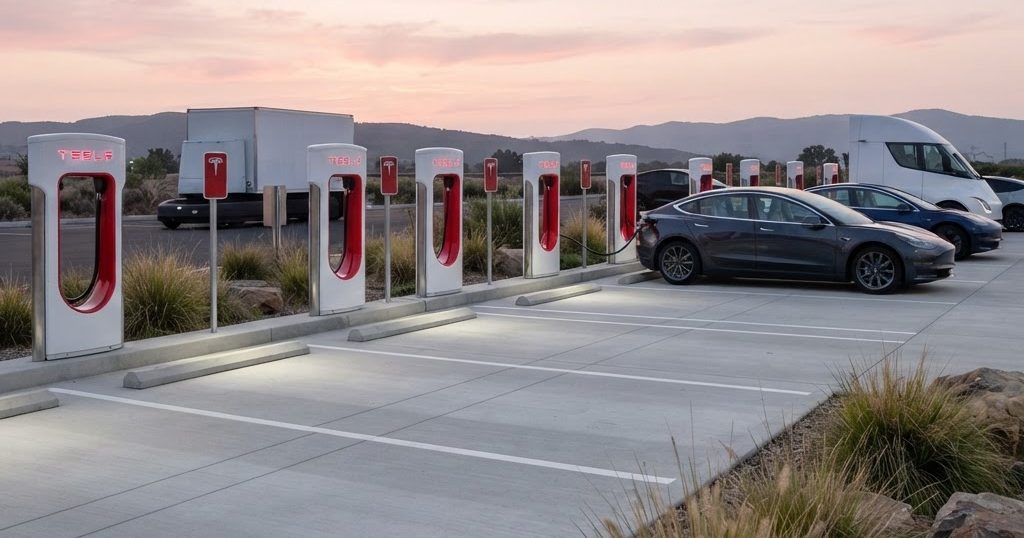
Because without fast charging along the highway, an electric car was a city car, and nobody else was going to build it. On September 24, 2012, three months after the first Model S deliveries, Tesla unveiled the Supercharger at its design studio in Hawthorne, California. There were six stations, all in California, enough to link Los Angeles, San Francisco, Lake Tahoe and Las Vegas. Each delivered close to 100 kW, and half an hour gave a Model S about three hours of driving at 60 mph. The roofs were solar carports from SolarCity, another company in Musk's orbit, designed to produce more energy over a year than the cars took. And the charging was free, with no end date. "We are giving Model S the ability to drive almost anywhere for free on pure sunlight," Musk said. Supercharging came standard on the 85 kWh Model S and was an option on the 60 kWh version.
Six stations in one state, though, did not make a car you could take anywhere.
So how did six stations become a coast-to-coast network?
By following the highways people actually drive, one corridor at a time. Tesla's plan named the routes: Vancouver to San Diego, Miami to Montreal, Los Angeles to New York, with Europe and Asia to start in the second half of 2013. Late in 2012 the first stations opened on the East Coast, along I-95 in Connecticut and Delaware. By mid-July 2013 there were 15 in the United States, and by October the West Coast route along I-5 and US-101 was open. In January 2014 the first coast-to-coast corridor was complete: Los Angeles to New York City, by way of Chicago. A Model S owner could now cross the country without paying for a single kilowatt-hour.
The more cars Tesla sold, the harder that word "free" became to keep.
What happened to "free, forever"?
It ended for new buyers in 2017, briefly came back, and then became a paid service. Model S and Model X cars ordered after January 15, 2017 no longer got unlimited free Supercharging. Cars that already had it kept it, and between August 2019 and May 2020 Tesla offered unlimited free Supercharging again for a while. Meanwhile the hardware kept getting faster: smaller 72 kW urban posts arrived in 2017, and the V3 Supercharger of 2019 delivered up to 250 kW. Busy stations full of paying drivers turned a sales argument into a business of its own.
A business that only serves your own cars, however, has a ceiling.
Why would Tesla let rival cars plug in?
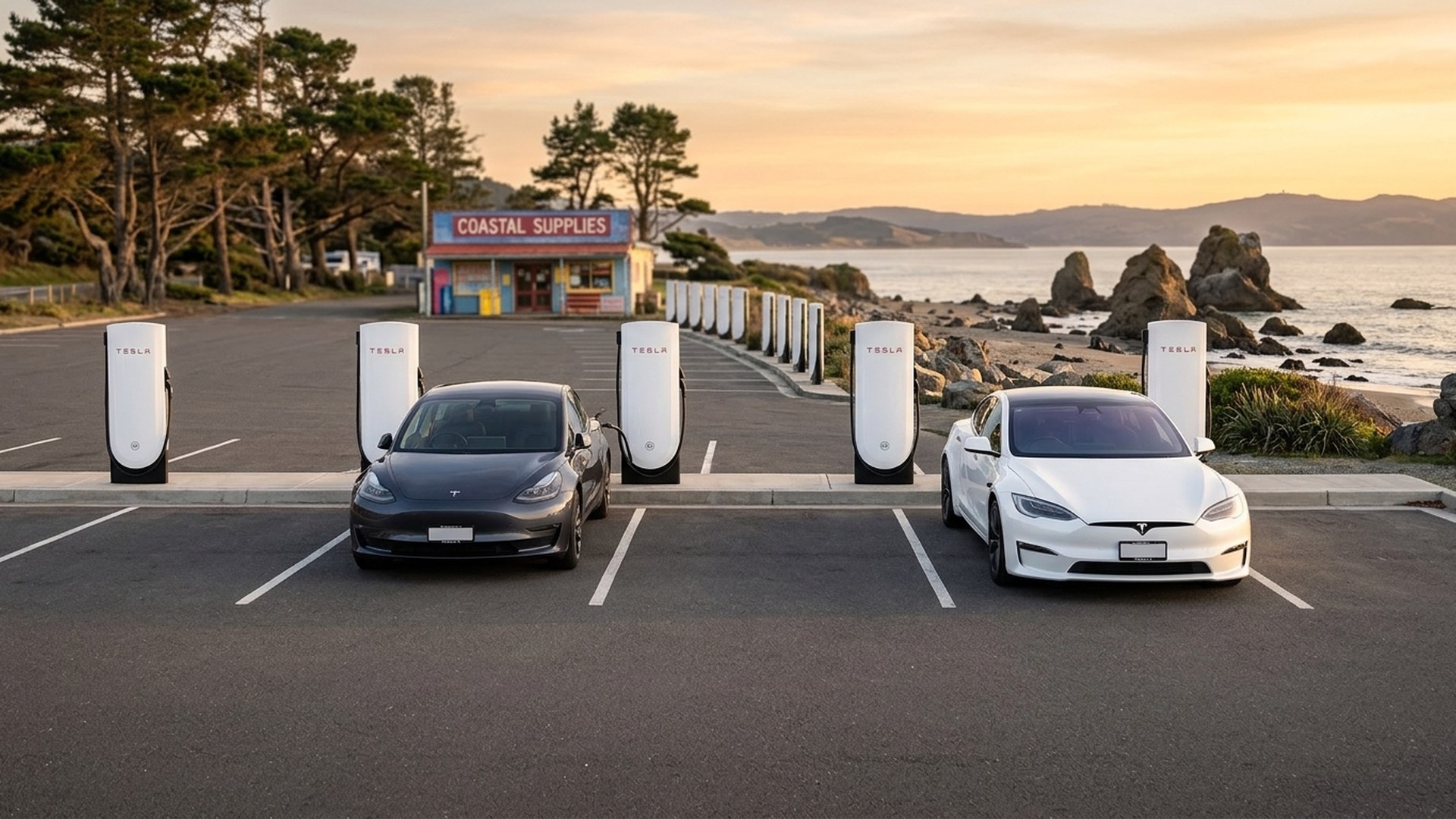
Because more cars at the plug meant more use of stations that were already built, and because Tesla's plug could become everyone's plug. In Europe the first step came from regulators: under their pressure, Tesla switched its new cars to the common CCS2 connector in 2018 and added CCS2 cables to its Superchargers. On November 1, 2021, the Netherlands became the test country, with ten Supercharger locations opened to other electric cars through the Tesla app. Norway, France, Germany, Italy, Spain, Sweden and the UK followed in 2022. In North America Tesla went further: in November 2022 it published its own plug design as the North American Charging Standard, and between May 2023 and February 2024 almost every major carmaker there signed up. In 2024 the plug became an official standard, SAE J3400.
Just as the network became the industry's standard, the team behind it was shown the door.
So how did the network survive losing its own team?
It slowed down for a while, but it never stopped growing. After the April 2024 firings Musk wrote that Tesla would still grow the network, but at a "slower pace" for new locations, and later that it would spend well over $500 million on expansion that year. Two Reuters sources said that was less than the original plan. Bloomberg reported that Tesla started rehiring some of the people it had let go, and the energy division took over the work. The numbers since then tell the rest. On April 3, 2026, Tesla announced its 80,000th Supercharger stall, at a 48-stall site in Saint-Saturnin near Le Mans, France. By October 1, 2026, the network had 9,007 stations with more than 85,000 connectors, and the newest V4 cabinets can deliver up to 500 kW, five times the power of the 2012 posts.
Numbers like that change what the network is really for.
Why does this story still matter?
Because the charging network is the part of Tesla that is hardest to copy. A rival can match a car's range or price in a few years. Thousands of sites with grid connections, permits and a decade of data on where drivers actually stop take far longer, which is exactly why other carmakers ended up adopting Tesla's plug instead of fighting it. Tesla is now repeating the idea for heavy trucks, with its own Megachargers for the Semi. The lesson of the Supercharger is a strange one: the "forever" in free charging did not last, and the team that built most of the network did not either. The network itself outlived both.
Sources (4)
- Tesla — Tesla Motors Launches Revolutionary Supercharger Enabling Convenient Long Distance Driving (2012)
- Wikipedia — Tesla Supercharger
- Manufacturing Business Technology — Former Tesla Supercharger Staffers Reveal Details of Department Fallout, Aftermath (citing Reuters)
- electrive — Tesla opens charging for third parties in the Netherlands
Images are illustrations; some are made with AI.