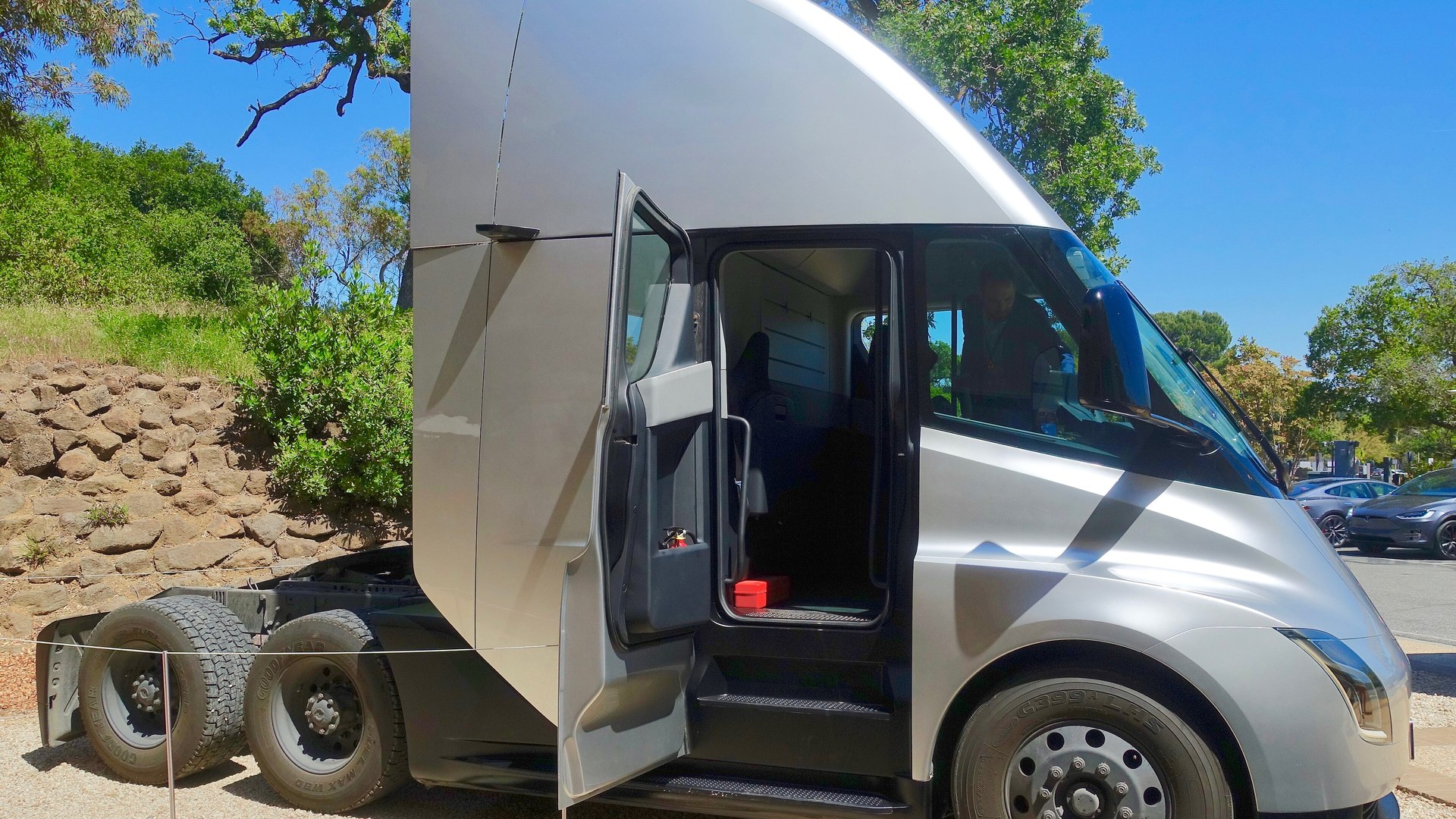
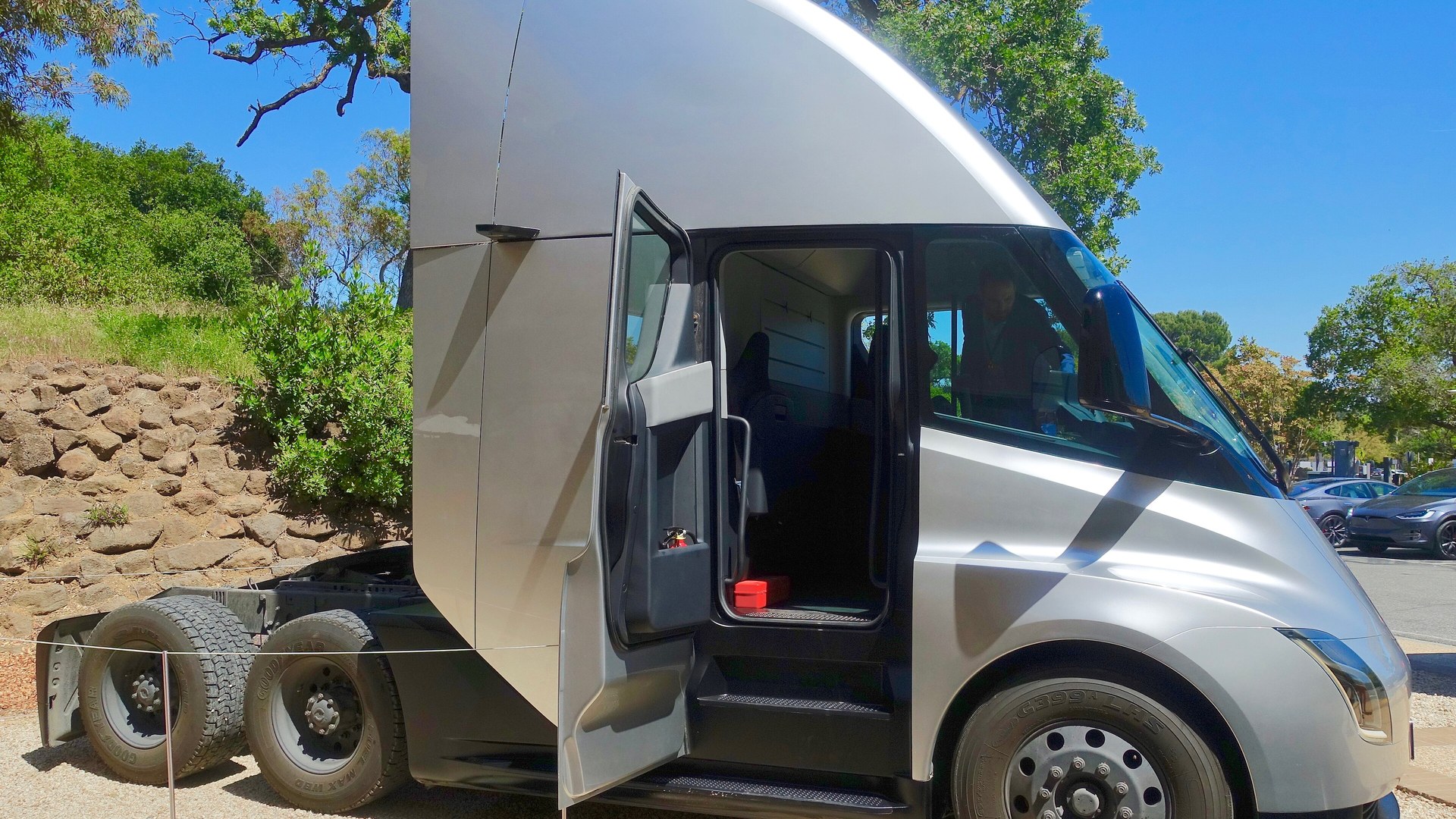
The Semi driver sits in a center seat
Inside the Tesla Semi: the center seat, the two 16-inch screens, the jump seat and the missing bed, and how charging fits a driver's legal breaks in the US and Europe.
Unlike almost every other heavy truck, the Tesla Semi puts its driver in the middle of the cab. The seat sits on the center line, a 16-inch touchscreen stands on each side of the wheel, ten outside cameras watch the road around the truck, and there is room to stand up, but no bed. Since September 24, 2026, Tesla has been handing over series-built Semis from its new truck factory in Nevada, and in early November the truck was shown in France ahead of European deliveries planned for 2027. That means more and more drivers will spend their working day in this cab. Whether that works depends on how the cab fits a real shift.
Why does the driver sit in the middle?
For the view, and because most trucks carry only one person. From the center seat the driver looks straight down the middle of the road instead of along one edge of the truck. Adam Wingfield, editorial director at FreightWaves, drove a production Semi in September 2026 and called the forward view better than in any truck he had driven. He accepted Tesla's reasoning that most trucking is done solo, so a passenger seat beside the driver is rarely used.
The middle seat also makes the cab symmetrical: the distance to each side and the camera image of each side are the same, which helps when reversing into a dock. But something is lost too. A driver in the middle can no longer look back along the trailer through an open window right next to the seat, a trick many truckers use when backing up. Without that window at the driver's elbow, the screens and cameras have to do much more of the work.
What do the two screens do?
The left screen is the dashboard, the right screen handles almost everything else. In the current Semi both are 16-inch touchscreens. Going by a ride-along video from May 2026, the left one works as the instrument cluster: trip data, the status of the truck's systems and a parking view that draws the area around the truck. The right one carries the map, climate, settings and music apps such as Spotify and Apple Music.
- Buttons on the edge: instead of the single dock along the bottom of a Model 3 or Model Y screen, each Semi screen has a vertical row of shortcuts on its outer edge, for example for the overhead deck lights, the seat height and the side camera views.
- Cameras: ten outside cameras and one inside the cab.
- Windows that open: early trucks had a small pop-out window. The production cab has side windows that roll down, so a driver can reach a gate reader, toll booth or call box.
Wingfield found the side view through cameras and mirrors workable, but not instant: he expects experienced drivers to need a couple of weeks to adjust. A cab is more than a cockpit, though. On a long shift it is also where a driver eats, waits and takes a break.
Is there a bed, a passenger seat or room to stand?
There is room to stand and a second seat, but no bed. The Semi is a day cab. At the first deliveries in December 2022, Tesla engineer Dan Priestley showed that even tall people can stand upright inside, and that a jump seat behind the driver, on the right, takes a passenger or a second driver. European versions add a heated and ventilated seat and acoustic glass.
Wingfield found the cab quiet and the ride good. A sleeper version is not coming soon: Tesla says it will only follow once there is a charging network for long-haul routes. No bed means the Semi is built around a shift that ends back at base, and the law decides how long that shift may be.
So what does a driver's day in a Semi look like?
A regional shift that starts with a phone and plans charging into the breaks. Based on what Tesla and test drivers have shown, a typical day looks like this:
- Start: the driver unlocks the truck with a phone, and the seat, mirrors and settings move to that driver's profile.
- Pre-trip check: much of it happens on the screen, including an onboard scale that shows the load.
- Route: a trip planner adjusts the expected range for weather, traffic and load. The Standard Range Semi is rated for about 325 miles (520 km) and the Long Range for about 500 miles (800 km), both at a gross weight of 82,000 pounds.
- Driving: three electric motors deliver up to 800 kW. Regenerative braking does most of the slowing down, so the normal brakes are mainly used at the end of a stop.
- The break: US rules allow up to 11 hours of driving in a 14-hour window and require a 30-minute break after 8 hours behind the wheel. At a Megacharger the Long Range Semi can take up to 1.2 MW, enough for about 60 percent in roughly 30 minutes.
In Europe the rules are stricter: at most 9 hours of driving a day (10 hours twice a week) and a 45-minute break after 4.5 hours. The European Semi charges at up to 800 kW, also about 60 percent in 30 minutes, and a slower 120 kW Basecharger fills it at the depot. On paper the day fits the rules neatly. How it holds up on real routes, with real chargers, is another matter.
What is still missing, and what changes in Europe?
Enough chargers, a sleeper cab and, for Europe, a different face. Wingfield's main doubt is not the cab but what surrounds it: 60 percent in 30 minutes only helps when a charger is free and working. He also points out that the Long Range truck weighs about 23,000 pounds, roughly 3,000 more than the Standard Range, which costs payload for dense, heavy freight.
The European Semi, shown at the IAA in Hanover in September and in France this autumn, replaces the side mirrors with cameras and the light bar with separate headlights. Tesla estimates about 550 km of range at the full European weight of 40 tonnes. The first trucks will come from Nevada in 2027. The center seat that looked like a stage gimmick in 2017 is now a working cab in the US, and from 2027 European drivers get to judge it for themselves.
Sources (4)
Images are illustrations; some are made with AI.