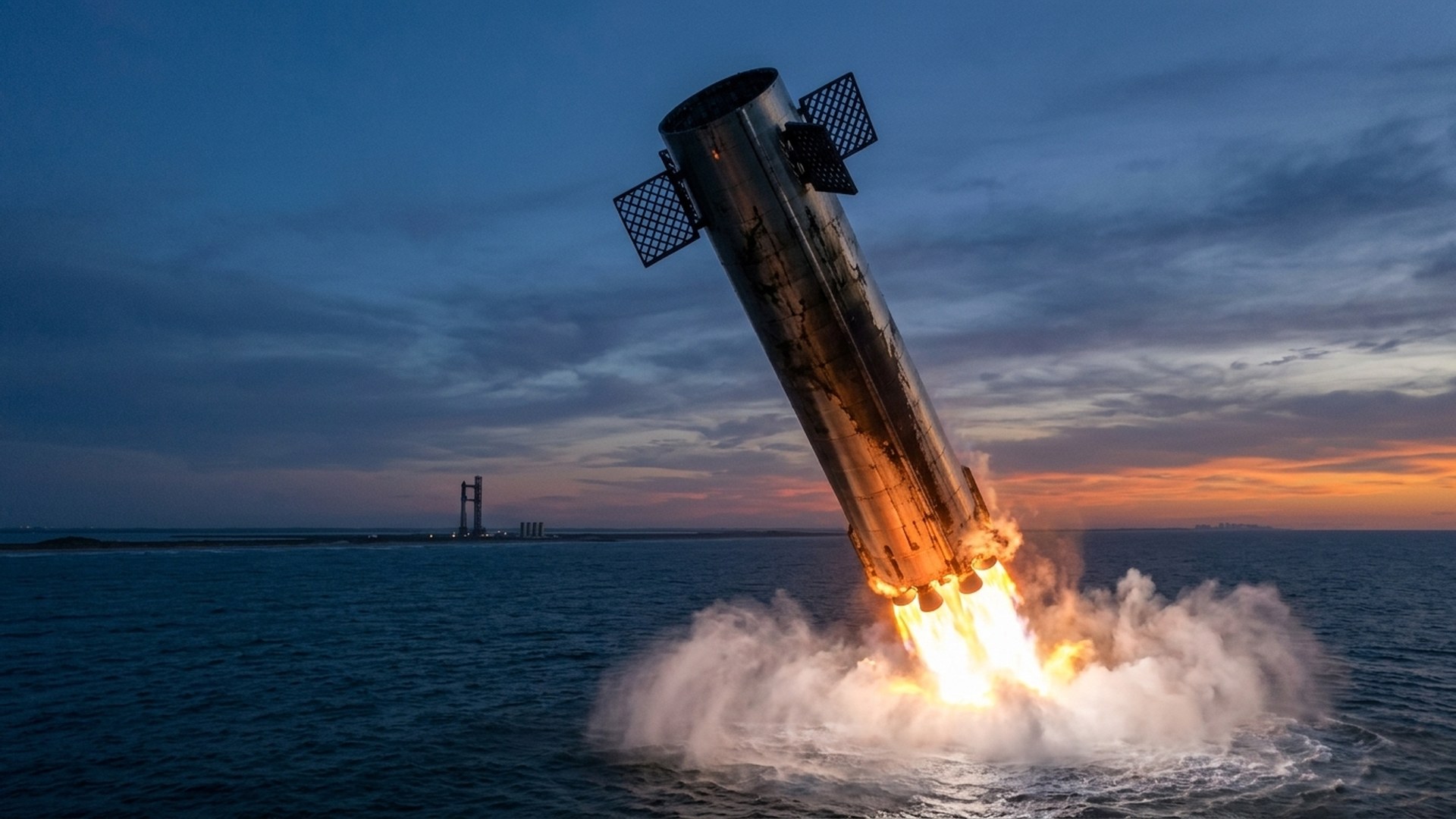
SpaceX caught a booster using giant chopsticks
Super Heavy was built without landing legs, betting everything on a tower that could catch it in midair. How the idea was born, how the first catch in October 2024 worked, and why it matters for every Starship flight since.
On the morning of October 13, 2024, a rocket booster taller than a 20-storey building fell back toward the tower it had launched from only minutes earlier. It slowed on its engines, slid sideways between two giant steel arms and stopped. Nobody had ever caught a rocket like that. SpaceX had bet the design of its biggest booster on this moment: Super Heavy has no landing legs at all. If the arms could not catch it, the plan for a fully reusable Starship had a hole right in the middle.
Why would anyone build a rocket without legs?
To save weight, money and time. The idea went public on December 30, 2020, when Elon Musk wrote that SpaceX would try to catch Super Heavy with the arm of its launch tower. Dropping the legs had three big advantages:
- Weight: every kilogram of landing gear is a kilogram that cannot carry cargo to orbit.
- Cost: legs are expensive hardware that has to be built, checked and repaired.
- Speed: a booster caught by the tower is already where it needs to be. Musk said it could go straight back onto the launch mount and be ready to fly again in under an hour.
Musk nicknamed the tower Mechazilla, and its two catch arms soon became known as the chopsticks. The idea was easy to draw and frightening to do. A booster about 71 metres (232 feet) tall, coming back from the edge of space, had to stop within reach of two arms, right next to the only pad that could launch the whole rocket. One mistake could destroy not just the booster, but the tower SpaceX needed for every future flight.
So how did SpaceX decide a catch was safe enough to try?
With thousands of checks and one human decision. Before Flight 5, SpaceX said a catch needed thousands of separate vehicle and pad conditions to be met. The booster would only head for the tower after a manual command from the Flight Director, sent before the end of the boostback burn, the engine firing that turns the booster back toward Texas. Without that command, or if the automatic health checks found a problem, the booster would steer away and make a soft splashdown in the Gulf of Mexico instead.
The rehearsals had already happened at sea. On Flight 4 in June 2024, the booster came down gently in the Gulf, right on target; SpaceX's Bill Gerstenmaier later said it hit its spot with about half a centimetre of accuracy. SpaceX said the rocket for Flight 5 was ready in early August. The Federal Aviation Administration still had to approve a changed launch licence, and it had warned this could take until late November. SpaceX called the extra environmental review "superfluous". The approval came weeks earlier than that, and the launch was set for a Sunday morning. Then the booster had a few minutes to prove that the whole idea worked.
What happened in those seven minutes?
Exactly what the drawings promised. Starship lifted off from Starbase in South Texas at about 7:25 a.m. local time. After the two stages separated, the booster flipped around, fired its engines to head home, and the Flight Director gave the go. About seven minutes after liftoff, Booster 12 came down beside the tower on its engines, slowed almost to a stop and moved sideways into the open arms. The arms closed around it. The engines shut down, and the booster hung there, held by the tower, scorched but in one piece. On SpaceX's livestream, engineer Kate Tice called it a day for the engineering history books.
The upper stage had its own job that morning. About 65 minutes after liftoff it came down over the Indian Ocean, fired three of its engines to hover just above the water, then tipped over and exploded. SpaceX had never planned to recover it. One catch could still be luck, and the next flights showed how thin the margins were.
Was the first catch just luck?
No, but the next ones were not automatic either. On Flight 6 in November 2024, the booster flew back, but the catch was called off because of concerns about the tower's hardware, and the booster went into the Gulf. That was the checklist doing its job: it chose a safe splashdown over a risky catch. On Flight 7, on January 16, 2025, the chopsticks caught a booster for the second time, and on Flight 8 in March 2025 for the third. In a few months, a world first had turned into something SpaceX simply plans for. The booster is only half of the rocket, though, and the other half is much harder to catch.
So why does that first catch still matter?
Because the next catch is the ship itself. For Flight 15, planned for November 2026, SpaceX wants to catch both stages: Booster 22 and, for the first time, the Starship upper stage, Ship 42. The ship returns from orbit through the full heat of re-entry, which makes it a far harder catch than the booster. Only when both stages come back to the tower can Starship become the fully and rapidly reusable rocket that SpaceX needs for cheap flights to the Moon and Mars.
It matters for Tesla too. The two companies are studying a possible merger, so a successful double catch is also news for Tesla shareholders. But the lasting lesson is older than any deal. On that October morning in 2024, a rocket without legs proved that the strangest part of the plan could work. Everything SpaceX wants to do next starts with that catch.
Sources (4)
- Scientific American: SpaceX Catches a Falling Starship, a First in Spaceflight History
- Spaceflight Now: Live coverage, SpaceX to attempt first booster catch during Starship Flight 5
- TechCrunch: Elon Musk says SpaceX will attempt to recover Super Heavy rocket by catching it with launch tower
- Interesting Engineering: Starship Flight 15, launch date, recovery goals and key tests
Images are illustrations; some are made with AI.