The flying Roadster still took nine years
In 2017 Elon Musk called flying cars noisy and dangerous; that same year he unveiled a Roadster that would end up flipping in midair. The story of the thruster tweet, nine years of slipped dates and the flight.
In April 2017, Elon Musk stood on the TED stage in Vancouver and explained why he did not like flying cars. They would be noisy, he said, the wind force would be very high, and one passing overhead was "not an anxiety-reducing situation". He even joked about a badly serviced hubcap coming off to guillotine him. In October 2026, his own Tesla Roadster drove upside down on a ramp, let go, flipped in midair and landed on its wheels. Tesla's vice president of vehicle engineering, Lars Moravy, summed it up as "Flying cars are real." The road between those two moments took nine years and a long list of missed dates.
What did Musk actually say about flying cars?
He called them a problem for the people underneath, not for the people inside. At TED, Musk was pitching The Boring Company: tunnels as the answer to traffic, because a city can stack as many tunnel levels as it needs. Flying cars were the obvious alternative, and he waved them away. His three objections were noise, the downwash from whatever keeps a car in the air, and the risk of something falling on your head. None of that said flying was impossible. It said flying over a city was a bad idea. Less than seven months later he unveiled a car that would make the question personal.
So where did a flying Roadster come from?
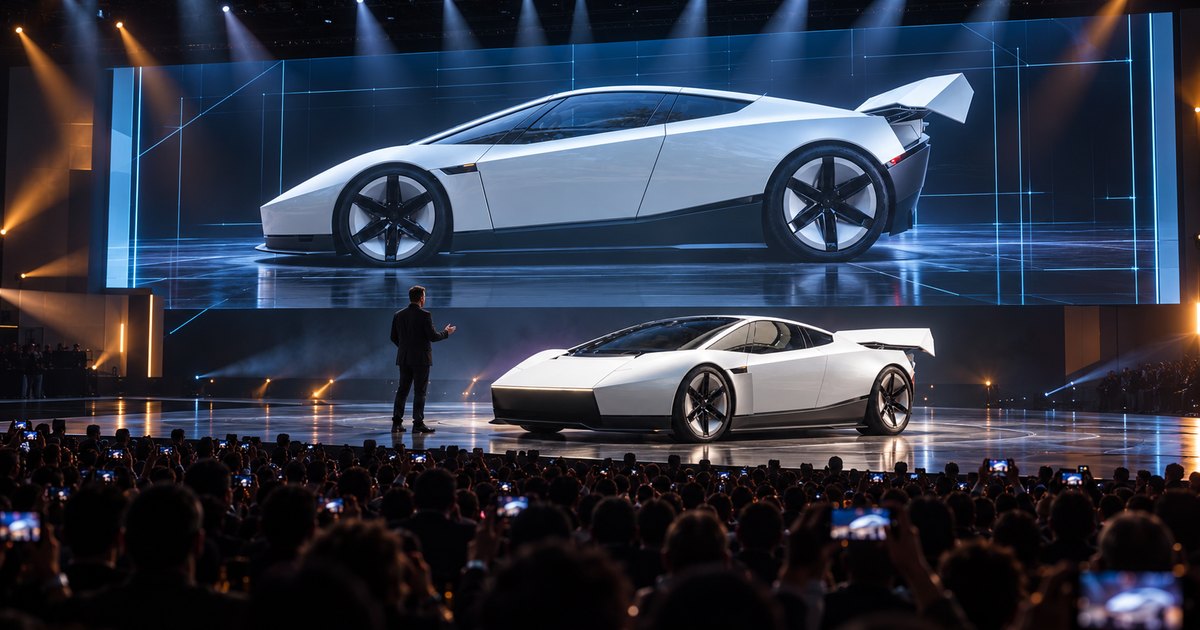
From a surprise at a truck launch and a tweet the following summer. In November 2017, at the end of the Tesla Semi reveal, a red Roadster rolled out of the trailer. Tesla promised 0 to 60 mph in 1.9 seconds, more than 600 miles of range and a 200 kWh battery, with production in 2020. Buyers could reserve one with a $50,000 deposit, or pay $250,000 up front for one of 1,000 Founders Series cars.
Then, on 9 June 2018, Musk added a twist on Twitter: a "SpaceX option package" for the Roadster that "will include ~10 small rocket thrusters arranged seamlessly around car". In early 2019 he went further and said the car would hover, or do something like it. A car that had been sold on acceleration was now being sold on lift. Promising it turned out to be far easier than building it.
Why did it take nine years?
Because every date slipped, again and again. In July 2020 Musk spoke of "the next 12-18 months". In January 2021 production moved to 2022, in September 2021 to 2023 and in May 2023 to 2024. In February 2024 he promised a production unveil by the end of that year and a goal of 0 to 60 mph in under one second. By late 2025 production had moved to 2027 or 2028, and a demo was set for 1 April 2026, a date Musk later called a joke.
2026 itself brought more delays. The demo became an "unveil" for late April, then late May or early June. In June, The Information reported that the SpaceX-made cold gas thruster system, internally called A71, still needed work, and the event moved to August or later. A first date of 1 October was called off because of severe weather; the event could only be held outdoors. Electrek counted at least six broken production promises along the way. Meanwhile many deposit holders had been waiting since 2017 or 2018. When the car finally did show up, it had to be worth that wait.
What happened when it finally flew?
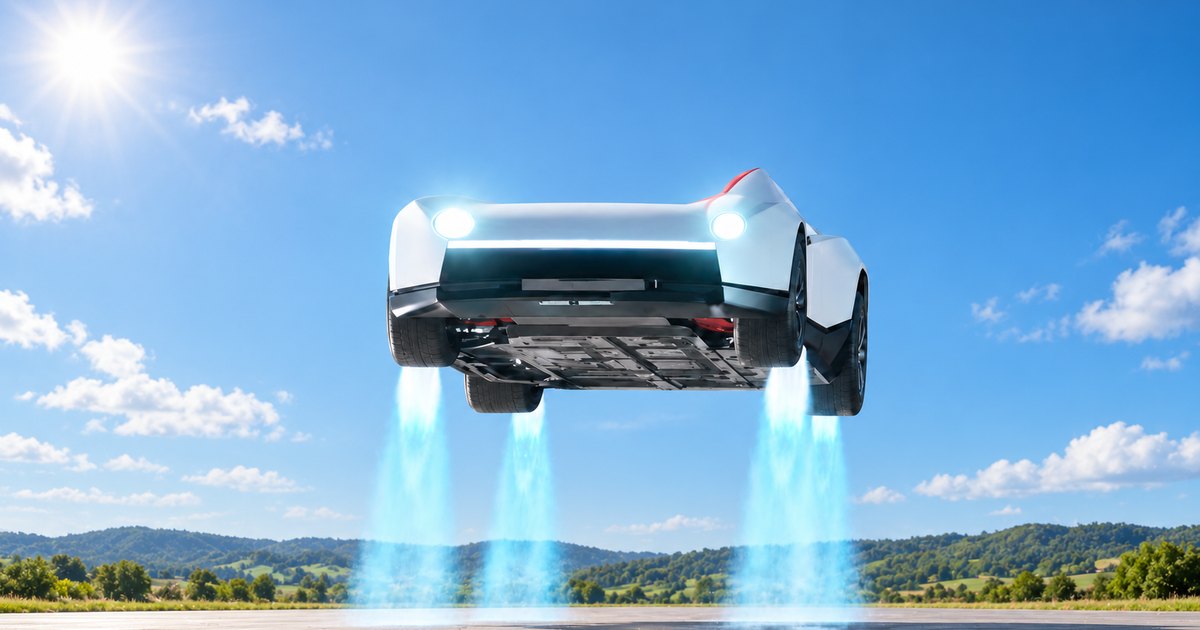
It drove upside down, let go, flipped and landed. The demo took place in mid-October 2026 at a SpaceX test site near Waco, Texas. Fans under the car sucked it onto a curved ramp until it hung upside down; it then detached, rotated in the air and came down on its wheels. In another run it jumped a row of Tesla vehicles with a Semi among them. Before the stunt Musk said it would "probably work"; afterwards: "Well, it worked." He set production for 2028.
The "rocket thrusters" of 2018 turned out to be nozzles blowing compressed nitrogen, the cold gas trick SpaceX uses to steer its boosters. Our explainer on how the Roadster flies runs the numbers: the push is more than three times the car's weight, but the tank is empty within seconds and takes hours to refill. That makes the obvious question harder to answer than it looks.
So did Musk change his mind about flying cars?
Not really: the Roadster jumps, it does not commute through the air. His 2017 objections were about cars flying over cities all day. The Roadster spends a few seconds of gas on a closed course and then lands; the top "Rocket" version is invite only and not meant for public roads. The noise and the downwash he warned about have not gone away; the Roadster simply uses them for a few seconds where nobody stands underneath. What changed is that the joke became a selling point.
The rest is still a promise. The flying has not been tested independently, the acceleration figures are Tesla's own, and Tesla's Q3 2026 update still listed the Roadster as "design development". After nine years, the honest summary is that the car can leave the ground, and the delivery date has not yet done the same.
Sources (4)
- Electrek — Elon Musk on the Boring Company, Semi truck and Mars: TED talk transcript (2017)
- Electrek — Musk: next-gen Roadster SpaceX package with rocket thrusters (2018)
- Electrek — Tesla Roadster unveil imminent after years of delays
- IBTimes UK — Musk shows Tesla Roadster's upside-down drive and mid-air flip after nine years of waiting
Images are illustrations; some are made with AI.